While it is not known to evolve into or from any other Pokémon, Arceus has a form for each of the eighteen types, which it can change into while holding a Plate or a type-specific Z-Crystal. Each form name is simply referred to as Arceus.
Like Darkrai and Shaymin before it, Arceus was not officially acknowledged by Nintendo until February 14, 2009, the year of its debut movie. It was later officially revealed to international audiences on August 3, 2009.
Arceus is the creator of the Pokémon of myth, the lake guardians, and the entire Pokémon universe. Known as the Original One (Japanese: そのものSono mono, "the very being") in Sinnoh myths, it was worshiped in ancient times by the people of Hisui under the name almighty Sinnoh (Japanese: シンオウ様Sinn'ō-sama).
Arceus is a white, equine Pokémon with an androgynous appearance. It resembles a qilin or centaur with a gray, vertically striated underside. The striated pattern also appears on the underside of its mane, tail, and face. Its four pointed feet are tipped with gold hooves. Its long mane juts away from its head, and its face is gray, with green eyes, red pupils, and a green circular pattern below its eyes. Arceus also has a streak of gold coloration on its head, which points upward. Its neck is fairly long, with two pairs of extrusions to the sides, and a flap-like feature on the neck's underside that is colored white like much of the body. Arceus also has a golden cross-like wheel attached to its body by its round abdomen. The wheel also has four green jewels attached to it. The pattern of striated gray of Arceus's underbelly continues past its waist. Its limbs have gray undersides and extrusions at the tops of the legs. Arceus's tail is similar to its mane in terms of shape and coloration. It is capable of flight.
According to Sinnohmythology, a single Pokémon Egg emerged from a vortex of complete chaos and nothingness predating the Pokémon universe. Arceus hatched from this egg and shaped the universe using its 1,000 arms, including the Sinnoh (then known as Hisui) and Ranseiregions. It also created the eggs from which the Pokémon of myth, Dialga, Palkia, and Giratina, and the lake guardians, Uxie, Azelf, and Mesprit, hatched from, and can recreate these eggs if it wants to. It is the oldest Pokémon in existence; as such, it is referred to as "Original One" in folklore. Arceus banished Giratina to the Distortion World due to its violent nature, and gave the lake guardians the power to control and calm either Dialga or Palkia should they become enraged. Like the Pokémon of myth, Arceus also resides in another dimension, a realm beyond time and space itself. There, it appears as a silhouette of golden light.
Arceus was also shown to be capable of speech, stating that "Arceus" is simply the name humans call it. The ancient Sinnoh people worshipped it, referring to it as "almighty Sinnoh," "great Sinnoh," and "might of Sinnoh," with the term "Sinnoh" later on becoming the name of the region. The Diamond Clan and Pearl Clan also worshipped it, though they mistook Dialga and Palkia respectively for Arceus. Both Palkia and Dialga's Origin Formes have body shapes similar to that of Arceus; this resemblance is believed to be a strategy in order to gain Arceus' powers. Professor Laventon describes Arceus as "the heavenly fount from which pours the light that shines across Hisui" and the protector of all Pokémon. In ancient myths, it is said that the Origin Ore, an ore of mysterious power, contains the power of Arceus itself.
As shown in Arceus and the Jewel of Life, Arceus was known to care for and safeguard the planet in ancient times, protecting the world from cataclysms such as meteors, and it would show gratitude and compassion to those who treated it with kindness. At the same time, Arceus does not suffer fools gladly; it will attack in a violent rampage if betrayed or deceived and holds long grudges if betrayed by those it considered friends. In modern times, Arceus continues to watch over the world and wishes for people and Pokémon to work together in the face of adversity. Even when it is needed, it only gives hints on how to solve problems instead of directly interfering. Arceus can also give its blessing to other Pokémon through bolts of light, making them bigger and more powerful, as seen with the ancient hero's 10 Pokémon companions. This blessing is passed down through family lines, as seen with the descendants of the hero's Pokémon: the noble Pokémon and ride Pokémon worshiped by the people of Hisui.
In Arceus and the Jewel of Life, Arceus is portrayed as having powers such as bringing back things that it once destroyed, making certain things vanish into thin air, halting time, and overturning the very laws of nature. In said movie, using its Earth, Splash, Meadow, Zap, and Draco Plates, it created the Jewel of Life, a powerful artifact capable of turning a desolate land into a rich and fertile one. In Hoopa and the Clash of Ages, it was shown to be able to stop the destruction caused by a space-time void. As shown in the Pokémon Journeys: The Series episode Showdown at the Gates of Warp!, Arceus has the power to not only calm Dialga and Palkia, but also destroy the Red Chain controlling them. Arceus also has the power to split in two, creating a piece of itself to exist outside of its realm. In Pokémon Legends: Arceus, Arceus transformed a normal smartphone into an Arc Phone, a device that allows humans to communicate with it through text messages. Arceus also has the power to appear in dreams and create a variety of Pokémon to serve as challenges, as seen in Eternal Battle Reverie. In Pokémon Masters EX, through the sync stone ultimate, Arceus can give its blessing to a Pokémon Trainer it deems worthy, transforming their outfits into costumes known as arc suits. As a result, their sync pair is blessed as well, granting them a divine move over their normal sync move.
Arceus has eighteen different forms, one for each type.
Through its Multitype Ability, Arceus can change its type at will by holding one of its Plates or a type-specific Z-Crystal. This causes its eyes, underbelly, face, hooves, snout, gems, and cross-like wheel to change color to match its current type. In Arceus and the Jewel of Life, it is also said to feed off the energy of its Plates.
In Alola, the Aether Foundation gathered Arceus's data from myths and legends told in Canalave City's library to create an artificial Pokémon with similar a similar ability to the Alpha Pokémon, being initially named Type: Full. Equipped with the RKS System, which allows it to simulate Arceus's Multitype through memories, it was developed during the Beast killer project to protect Alola from the Ultra Beasts. However, the project was deemed a failure and was later abandoned, and Type: Full's Ability was sealed with a control helmet, which caused it to devolve and be renamed Type: Null. Gladion eventually discovered it and renamed it Silvally, with their newfound bond allowing it to reawaken its dormant powers.
Pokémon Super Mystery Dungeon: Arceus appears when Dark Matter begins trying to take the Tree of Life to the sun, leading the other Pokémon in attempting to stop its ascent. He is able to telepathically reach the player thanks to Mewtwo and transports them to the Tree of Life's roots to confront Dark Matter. When Dark Matter regenerates itself and sends out a massive shockwave, Arceus and the other Legendary Pokémon gathered to stop the Tree of Life are immediately turned to stone. After Dark Matter is defeated, Arceus will remain at the top of Destiny Tower.
Pokémon Legends: Arceus: Arceus is the titular character of the game. It sends the player characterback in time to the Hisui region and gives them the mission of seeking out all Pokémon in Hisui. Throughout the game, Arceus occasionally communicates with and assists the player via the Arc Phone.
Pokémon Masters EX: While not physically seen, Arceus plays a notable role during the eponymously named Arceus arc as the creator of sync stones ultimate. Asking the people of Pasio to demonstrate their bond with their Pokémon to it, Arceus grants sync pairs holding sync stones ultimate new costumes dubbed arc suits if the aforementioned bond is strong enough.
Pokédex entries
This Pokémon was unavailable prior to Generation IV.
It is the heavenly fount from which pours the light that shines across Hisui. Its luminance guides and protects all Pokémon. Hisuian mythology states that Arceus is the creator of all things.
Arceus has multiple different forms that it switches between with its AbilityMultitype, with each of its forms having a different type. In total, it has eighteen different forms, one for each type. Though most of its forms were introduced in Generation IV, its Fairy-type form was introduced in Generation VI, along with the Fairy-type as a whole.
By default, Arceus is in its Normal-type form. If it holds (or, in Pokémon Legends: Arceus, is exposed to) a Plate or type-specific Z-Crystal, it changes its form to be the same type as the type the Plate or Z-Crystal corresponds to.
In games besides Pokémon Legends: Arceus, Arceus's signature moveJudgment is Normal-type by default, but changes to match the type of the Plate that it holds (being unaffected by Z-Crystals). In Legends: Arceus, the type of Judgment is directly determined by Arceus's form, such that its type always matches that of Arceus; additionally, Arceus can change its form during a battle using the Legend Plate. After being exposed to the Legend Plate, it will be in its Normal-type form by default and change its form before using Judgment to have a type advantage over the target, which also changes Judgment's type to match Arceus's. When determining the type that it changes into, any double weaknesses that the target may have are prioritized, followed by a type that resists the target's primary type (prioritizing immunities), then a type that resists the target's secondary type (again prioritizing immunities); if multiple types are equally valid, one of them is chosen at random. Arceus reverts to its Normal-type form when the battle ends. Arceus has a unique form change animation when using the Legend Plate, which shows it being enveloped in light from a Plate to change its form. If Arceus is deposited into Pokémon HOME while in any of its alternate forms, it reverts to its Normal-type form; if it is under the effects of the Legend Plate when deposited into HOME, these effects wear off.
In addition to its changing type, Arceus's Pokéathlon performance differs depending on its form, and it can only learn Draco Meteor from a Move Tutor while in its Dragon-type form (though it can learn it via TM in any form).
???-type Arceus sprite
In the Generation IV games, there is an unused ???-type Arceus, but it cannot be legitimately obtained in the games, as there is no ???-type Plate. Due to how its Ability would automatically turn any Arceus without a Plate into a Normal-type Pokémon in Generation IV, a ???-type Arceus hacked into the game will be treated as Normal-type. This form was removed in Generation V due to the removal of the ??? type.
Prior to Pokémon Omega Ruby and Alpha Sapphire, Arceus's alternate forms were not registered separately in the Pokédex. All of its forms are named simply "Arceus" in the Pokédex.
In Pokémon Mystery Dungeon (WiiWare), Arceus will be present in its Water, Electric or Fire-type form, depending on the game, as Plates do not exist. In Pokémon Super Mystery Dungeon, only its Normal-type form is available, with Multitype serving a different function.
Arceus debuted in Arceus and the Jewel of Life. It was angry at the people of Michina Town for Damos's unwitting betrayal of it in ancient times, and so it attempted to destroy the world. When Ash, his friends, and Sheena were teleported by Dialga to ancient times, they directly influenced the event, changing the future for the better so that Arceus would stop its destruction.
Arceus made its animated series debut as a silhouette in Showdown at the Gates of Warp!. It was called upon by Ash, his friends, their alternate world counterparts, and the people in both of their worlds to help stop Dialga and Palkia's fight and destroy the Red Chain that was forcing them to battle.
An Arceus briefly appeared as a silhouette in GOTCHA!.
In the manga
Arceus in Pokémon AdventuresArceus's various forms in Pokémon Adventures
Movie adaptations
Arceus appears as a central character in the Arceus and the Jewel of Life manga adaptation, reprising its role from the movie. After Arceus saved the world from a meteor, Damos took care of it. It gave Damos the Jewel of Life to make the land of Michina Town rich and fertile. Damos then "betrayed" Arceus, and it has been outraged ever since.
Arceus appears in the TCG in all types but Fairy. Cards based on Arceus first appeared in the Arceus expansion set, which were printed with a rule that allows players to have as many Arceus cards in their deck as they like.
In Pokémon Masters EX, Arceus is called a Legendary Pokémon by Norman in the "Challenge the Normal Types" Daily Type Rotation event and by Misty in her arc suit in one of her random conversations in the Pokémon Center.
The official English website of Pokémon Legends: Arceus used to refer to Arceus as a Legendary Pokémon, which was later corrected to Mythical Pokémon as of September 28, 2021.[2] On the Japanese website, it has been referred to as a Mythical Pokémon from the beginning.[3]
Arceus's Flying-type form is the first Pokémon to be pure Flying-type, making the type the last one to have a single-type Pokémon. Tornadus would later be introduced as the first Pokémon to be pure Flying-type in its default form.
Due to being a pure Flying-type, Flying-type Arceus and Tornadus are the only Pokémon that can have the Flying-type backdrop in the Hall of Fame after defeating the Pokémon League in Black and White and Black 2 and White 2. This backdrop will always reflect the Pokémon's primary type, but all half-Flying-type Pokémon had Flying as their secondary type prior to Generation VI.
Arceus has the highest base stat total of all Normal-type Pokémon and the highest base stat total of any Pokémon in its base form.
Arceus has the highest base stat total of all Mythical Pokémon.
In its alternate forms, Arceus has the highest base stat total of all Rock, Bug, Ghost, Steel, Grass, Electric, Ice, Dark, and Fairy-type Pokémon.
Arceus is the only Pokémon with a base stat total of 720.
In Generation IV, it was impossible to legitimately give Arceus more than 100 EVs in any stat, since it was only ever distributed at level 100. Prior to Generation V, level 100 Pokémon could not gain EVs through battling because they could not gain experience.
Prior to Generation VII, Arceus was classified by Pokédex color sorting as gray.
In Pokémon Legends: Arceus, Arceus is the only Pokémon that can be registered in the player's Pokédex and have a research level of 0 at the same time.
Arceus is the only pre-Generation V Pokémon to never officially receive a DPBP number. Kadabra, which was not released as a TCG card during the DPBP era, is assumed to be #070, as Abra and Alakazam are #069 and #071, respectively.
Arceus was the only Pokémon first introduced during the DPt era of the Japanese Pokémon Trading Card Game. In the international TCG, Arceus and Shaymin were both introduced in the Platinum series.
The origin mark for Legends: Arceus and the symbols for the Arceus expansion and the Brilliant Stars expansion resemble Arceus's rings.
Ever since Arceus's debut, certain aspects of the Pokémon series have made use of its iconography.
In Pokémon Mystery Dungeon: Explorers of Sky, the Space Globe (Japanese: じくうのオーブ Space-Time Orb) is an item that is described as the ultimate globe that holds the power to pass through space and time. It resembles Arceus's attached wheel and can be found on a statue of Arceus.
Arceus and Silvally have similar Shiny colorations, swapping their usual white to a light gold.
The name of the Ability RKS System is a reference to Arceus, with its English name being similar to the pronunciation of "Arceus". In German, Spanish, French, and Italian, its name is instead a reference to Arceus's category, the Alpha Pokémon.
The company RKS Laboratories (Japanese: アルセウス製薬 Arceus Pharma) in Galar has a logo similar to the rings on Arceus's body, furthering the connection.
Arceus received the most votes of all pre-Generation V Pokémon in the Pokémon Global Linkpromotion poll in both the Japanese poll and the international (non-Japanese and non-Korean) poll.
Origin
Arceus appears to be particularly based on a creator deity, present in many world cultures. Arceus also appears to draw significant inspiration from Classical Greece, evident in the (putative) onomastic nod to Zeus, ruler of Mount Olympus; in the ancient Greek style settings that frequently frame its epiphanies, such as rows of classical columns, stepped stone platforms, and straight processional approaches typical of Greek sanctuaries; and in the Classical Greek styling favored by Arceus devotees such as Volo, with tunic-like layering and a himation-like draped cloak. Its cosmogonic emergence “from an egg” resonates with the Orphic Egg and the birth of Phanes/Protogonos, as well as the broader World egg motif found across numerous creation myths. The gold, cross-spoked ring fused around a white, near-abstract body operates as a built-in nimbus or solar crown in the manner of Helios or a stylized halo, a widespread religious icon used to denote holy, divine, or sacred figures and, at various periods, rulers, heroes, and saints. The triadic delegation of domains (time, space, distortion) parallels the classical division of realms among Zeus, Poseidon, and Hades, while Giratina’s banishment functions as a Tartarean containment of rebellious force.
Arceus may be a combination of ἀρχήărkhḗ (Ancient Greek for "origin" and "dominion") and Zeus (supreme deity of the Greek pantheon who rules as the king of gods in Mount Olympia) where the former is cognate with the prefix arch- (indicating "chief" or "extreme") and the latter is a cognate with deus (Latin for "deity"). It may also involve alpha (first letter of the Greek alphabet; English name of this Pokémon's category), arcane (esoteric), aureus (Latin for "golden"), arc (part of a circle; curve), arcessō (Latin for "I summon"), Archeus (an aspect of the astral plane), or Chaos (origin state of the universe in Greek mythology that is often personified as the first primordial deity).
This Pokémon article is part of Project Pokédex, a Bulbapedia project that aims to write comprehensive articles on each Pokémon species, as well as Pokémon groups and forms.


 Rowap Berry (100%)
 Silk Scarf (???%)


 For other sprites and images, please see Arceus images on the Bulbagarden Archives.
 Fire-type Arceus
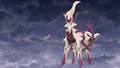 Ghost-type Arceus
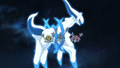 Water-type Arceus


 and the symbols for the Arceus expansion
  and the Brilliant Stars expansion
  resemble Arceus's rings.


