There are a total of 20 different patterns Vivillon can have on its wings, one of which is event-exclusive.
In GenerationsVI and VII, Vivillon's pattern depends on the real-world geographic location set on the game the Pokémon was generated in.
In Pokémon Scarlet and Violet, Spewpa will always evolve into Fancy Pattern Vivillon, except if the Spewpa was transferred from another game via Pokémon HOME, or when the pattern Spewpa can evolve into has been changed by receiving a Postcard from Pokémon GO.
Vivillon is a butterfly-like Pokémon with wings that come in a large variety of patterns. It has a round, grayish head with large, black, pixelated eyes and a pair of skinny antennae. The tips of the antennae each have an ovoid scale that is dark gray on the upper half and beige on the lower half. Vivillon's thorax is an ovoid and divided into three segments; each segment is a different shade of gray. Its legs are also ovoid and are dark gray on the lower half, beige on the upper half, and have a black band in the middle. It has two black, circular hands and no visible arms. While Vivillon's wings come in a wide variety of colors and patterns, they always have black edges and pixelated markings. It can spread its scales to poison its opponents during battle or, as seen in the Pokémon the Series: XY episode To Catch a Pokémon Smuggler!, to calm an opponent's fighting spirit. It is highly capable of finding sources of water, such as springs.
The patterns on a Vivillon's wings adapt to the environment. Even on the same island, you can find different Vivillon in areas with different climates.
The patterns on a Vivillon's wings adapt to the environment. Even on the same island, you can find different Vivillon in areas with different climates.
The patterns on a Vivillon's wings adapt to the environment. Even on the same island, you can find different Vivillon in areas with different climates.
Form data
Map of Vivillon locations in Generations VI and VIIOfficial maps describing Vivillon locations in Generations VI and VIIOfficial maps describing Vivillon locations in Generations VI and VIIOfficial map describing Vivillon locations via Postcards in Generation IX
Vivillon has 20 distinct forms, each having different patterns on its wings. Its form cannot be changed. Scatterbug and Spewpa have the pattern of Vivillon that they will evolve into already set when the Pokémon is generated; for Eggs, this means the game in which the Egg was created, regardless of parents.
In Generation VI and Generation VII, its pattern depends on which geographic location the user specified on the Nintendo 3DS at the time the save file was created. This affects all Vivillon encountered within the game and can only be changed later by deleting the save file and creating a new one. Due to region locking, a Nintendo 3DS system can only pick from a certain subset of geographic locations, depending on which region the system is from. For a comprehensive list, see List of Nintendo 3DS country and region settings.
In Pokémon Scarlet and Violet, all wild Vivillon have the Fancy Pattern by default (though other patterns are used by some NPCs). However, transferring a Postcard from Pokémon GO using the Mystery Gift feature in Pokémon Scarlet and Violet will change the pattern of all wild Vivillon to match the location the Postcard came from. Wild Scatterbug and Spewpa caught after receiving the Postcard will also evolve into Vivillon matching the Postcard's pattern. Scatterbug and Spewpa caught prior to receiving the Postcard will not evolve with the Postcard's pattern. After 24 hours, the wild Pokémon will revert back to Fancy Pattern unless another Postcard has been used. Changing the time and date of the Nintendo Switch system may end the effect prematurely. An account cannot send more than one Postcard per day, but multiple accounts can be linked each day and can each send a Postcard. A Pokémon Scarlet and Violet save file may not receive the same Postcard more than once. All hatched Scatterbug will evolve into the Fancy Pattern regardless of Postcard effects. Using the Union Circle feature, players can see and catch wild Vivillon from other players' games, allowing them to catch various patterns of Vivillon regardless of whether they own a matching Postcard.
In Pokémon Legends: Z-A, all wild Vivillon in Lumiose City have the Meadow Pattern. In the Mega Dimension DLC, all wild Vivillon in Hyperspace Lumiose have the Garden Pattern. Likewise, wild Scatterbug and Spewpa will evolve into Meadow Pattern (if obtained in Lumiose) or Garden Pattern (if obtained in Hyperspace). However, the Spewpa received after completing Side Mission 021: "Spewpa in the Museum" will instead evolve into Marine Pattern. The other 17 patterns are obtainable only by transferring them from Pokémon HOME.
18 of the patterns correspond to certain regions, while the other two do not. The regions corresponding to each pattern differ somewhat between the Nintendo 3DS and Pokémon GO.
Far northern regions of Norway and Russia, all of Finland except Åland, Canada's Northwest and Yukon Territories, and Antarctica.[2]
Polar
Alaska, the region of Magallanes in Chile, the provinces of Tierra del Fuego and Santa Cruz in Argentina, the northeastern United States, large sections of Canada, and areas of Sweden.
Tundra
Norway, Iceland, and the Hokkaido region of Japan.
Continental
China, Denmark, Germany, some provinces of Argentina, South Korea, and the Netherlands.
Garden
United Kingdom, Ireland, New Zealand, and Tasmania in Australia.
All wild Vivillon in Hyperspace Lumiose in Pokémon Legends: Z-A have the Garden Pattern, regardless of the set geographic location of the Nintendo Switch system.
Elegant
Most areas of Japan.
Meadow
Large sections of France, the Catalonia region of Spain, and most of the Northern part of Italy.
Puerto Rico, Anguilla, the Dominican Republic, Haiti, northern Venezuela, the Atlántico, La Guajira, and Magdalena Departments of Colombia, the state of Yucatán in Mexico, and the tip of South Africa.
High Plains
Western United States, the British Columbia province of Canada, northern Mexico, southwestern Russia, northeastern Turkey, northwestern China, and Azerbaijan.
Sandstorm
Throughout the Middle East and parts of Turkey.
River
Most regions of Australia, the Canary Islands of Spain, and several African countries.
Monsoon
India, Hong Kong, Okinawa, Tibet, and Taiwan.
Savanna
Various provinces of Argentina, all of Brazil except some northern states, southern Peru, Paraguay, Uruguay, and Bolivia.
Sun
Throughout southern Mexico, Guatemala, Honduras, Nicaragua, El Salvador, Belize, Zimbabwe, and the Northern Territory of Australia.
Ocean
Hawaii and Réunion.
Jungle
Malaysia, all of Colombia except the Atlántico, La Guajira, and Magdalena Departments, central and southern Venezuela, northern Peru, Panama, Costa Rica, Singapore, some states in northern Brazil (namely Acre, Amapá, Amazonas, Rondônia, and Roraima), French Guiana, and the state of Kerala in southwest India.
By default, all Vivillon in Pokémon Scarlet and Violet have the Fancy Pattern, regardless of the set geographic location of the Nintendo Switch system; however, receiving a Postcard changes the pattern of wild Vivillon for 24 hours.
Poké Ball
This event-exclusive pattern resembles a standard Poké Ball. It was first distributed in Paris, France to promote the temporary Pokémon Center store.
Multiple Vivillon appeared in To Catch a Pokémon Smuggler!. They debuted in their Continental, Elegant, Garden, Icy Snow, Savanna, and Sun Pattern forms in this episode, having evolved from a group of Spewpa that had been targeted by Dolan.
Vivillon, the Scale Pokémon. Vivillon are skillfully able to find a source of water. It has been said that you'll find a spring if you follow a Vivillon.
In Dancing Vivillon and Burning Fletchinder, fifteen Sky Trainers were hypnotized by Malva and used fifteen Vivillon, each with a different Pattern. The Vivillon Patterns which debuted were the Archipelago, Continental, Elegant, Garden, High Plains, Icy Snow, Jungle, Modern, Monsoon, Polar, River, Sandstorm, Savanna, Sun, and Tundra Patterns. The leader of these Sky Trainers, Yvette, has mentioned that she has 18 of the Vivillon Patterns, including the Poké Ball and Fancy Patterns. After their defeat and no longer being hypnotized the Vivillon safely land the Sky Trainers down in Shooting Frogadier. Yvette later uses a Marine Pattern Vivillon with her other Vivillon and in conjunction with Viola's Meadow Pattern Vivillon.
Archipelago, Continental, Elegant, Polar and Icy Snow Pattern Vivillon in Pokémon Adventures
Archipelago, Sun, Savanna, Monsoon, Modern, High Plains, Icy Snow, River, Tundra, Polar, Sandstorm, Modern, Marine, Garden and Elegant Pattern Vivillon in Pokémon Adventures
Vivillon is pronounced "Vi-vi-yon" according to the official Pokémon GO website.[3] The pronunciation was also given as "VIH-vee-yon" in a challenge featuring commonly mispronounced Pokémon names at the 2026 Latin America International Championships.[4]
Despite the Icy Snow Pattern being the first Vivillon form listed in the Pokédex, the Meadow Pattern is usually treated as Vivillon's primary form, being the form depicted in its key art and seen most often in official artwork, websites, and other material outside the core series games (such as the animated series, the TCG, the manga, and the spin-off games), as well as being the form of all wild Vivillon in Lumiose City in Pokémon Legends: Z-A. This may be due to the Meadow Pattern being found in France, which Kalos (the region Vivillon debuted in) is based on.
In Pokémon HOME, each of Vivillon's forms are listed under distinct color groupings based on the color of their wings.
Since the release of Pokémon HOME, Vivillon is listed under the most Pokédexcolor groupings of any Pokémon, with a total of nine. The only color grouping to not contain any of Vivillon's forms is black.
Meadow Pattern and Fancy Pattern Vivillon are the only pinkBug-type Pokémon.
They learn many of the same moves, albeit at different levels.
Up until Generation IX, Vivillon could not learn Iron Defense directly, even though its pre-evolved form, Spewpa, was able to learn this move from a Move Tutor.
As of Generation IX, Vivillon has the most Pokédex entries for a single Pokémon, with 20 per game (one for each form).
In Pokémon Scarlet and Violet prior to Version 1.2.0, only some of these 20 entries were accessible, as Spewpa could only evolve into Fancy Pattern Vivillon, and only a few other entries could be gained from NPC encounters.
It has never been possible to obtain Scatterbug and Spewpa that evolve into Vivillon's Poké Ball Pattern, despite the fact the Pokédex in the mobile version of Pokémon HOME shows the same evolutionary line for Poké Ball Pattern as the other forms. This was also true of the Fancy Pattern prior to the release of Pokémon Scarlet and Violet.
While the Ocean Pattern Vivillon has not made any proper animated appearance, Harper was seen flying with its wings as part of an illusion created by a Mismagius in A Haunted House for Everyone!.
Origin
Considering the many different varieties of Vivillon that differ depending on the player's geographic location, Vivillon may have been based on Papilio dardanus, which is known for having over 14 known morphs, each of which mimics a different distasteful species of butterfly. Its block-like wing patterns may be based on pixel art. Modern Pattern Vivillon in particular may be based on modern art, specifically the De Stijl movement.
Name origin
Vivillon and Viviyon may be a combination of vivid and papillon (French for "butterfly"). It may also involve 美 bi (Japanese for beauty) or brillant (French for "brilliant").
This Pokémon article is part of Project Pokédex, a Bulbapedia project that aims to write comprehensive articles on each Pokémon species, as well as Pokémon groups and forms.


 For other sprites and images, please see Vivillon images on the Bulbagarden Archives.
 Elegant Pattern Vivillon in Pokémon the Series: XY
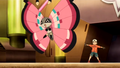 Meadow Pattern Vivillon in Pokémon the Series: XY
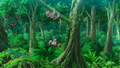 Jungle Pattern Vivillon in Pokémon Journeys: The Series
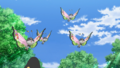 Fancy Pattern Vivillon in Pokémon Horizons: The Series
 Sun Pattern Vivillon in Pokémon Horizons: The Series


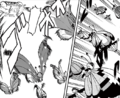 Archipelago, Continental, Elegant, Polar and Icy Snow Pattern Vivillon in Pokémon Adventures
 Poké Ball and Fancy Pattern Vivillon in Pokémon Adventures
 Sun and Savanna Pattern Vivillon in Pokémon Adventures
 Archipelago, Sun, Savanna, Monsoon, Modern, High Plains, Icy Snow, River, Tundra, Polar, Sandstorm, Modern, Marine, Garden and Elegant Pattern Vivillon in Pokémon Adventures


 shape.