

Appendix:Fan terminology
The Pokémon franchise has a wide range of fanmade terminology for various aspects of the games. These are colloquial terms originating from unofficial sources, and are thusly not found in official media. However, some terms originally coined by the fandom have been used officially, such as Eeveelution and Shiny; these terms are not listed here.
Pokémon terms
Counterparts
A set of two version-exclusive Pokémon and their evolutionary lines, each found in a different game, sometimes referred to as parallels. These counterparts may be identified by commonalities such as typing, base stats, Evolution method, and the locations where these Pokémon may be found. The term may also be used to describe Pokémon that are more common in one game version than another, as well as Pokémon that are only exclusive in a single pair of games.
Convergent form/Convergent Pokémon
- Main article: Convergent species
Fan terms for Generation IX Pokémon which resemble another species without being related biologically. These refer to the Wiglett, Toedscool, and Poltchageist lines, whose designs are based on the Diglett, Tentacool, and Sinistea lines, respectively. The term is derived from the real-world phenomenon of convergent evolution. Alternatively, some fans call them "regional fakes" as this concept resembles the previously introduced regional forms.
Early-route Pokémon
A Pokémon found in the first few routes of the game. These can be divided into:
- Early-route Pokémon that are based on mammals and are either Normal or Dark types: Rattata, Sentret, Poochyena, Zigzagoon, Bidoof, Patrat, Lillipup, Purrloin, Bunnelby, Yungoos, Skwovet, Nickit, Wooloo, Lechonk, and Tandemaus;
- Early-route Flying-type bird Pokémon: Pidgey, Spearow, Hoothoot, Taillow, Wingull, Starly, Pidove, Fletchling, Pikipek, Rookidee, Squawkabilly, and Wattrel;
- Early-route Bug-types: Caterpie, Weedle, Ledyba, Spinarak, Wurmple, Kricketot, Sewaddle, Venipede, Scatterbug, Grubbin, Cutiefly, Blipbug, Tarountula, and Nymble.
While there are no official names for these groupings, some of these Pokémon (from the first eight generations) were grouped together in the Pokémon 1008 ENCOUNTERS video.
Electric rodents
- Main article: Electric rodents
A group of Electric-type Pokémon based on rodents, consisting of Pikachu, Raichu (sometimes omitted), Pichu (sometimes omitted), Plusle, Minun, Pachirisu, Emolga, Dedenne, Togedemaru, Morpeko, Pawmi, Pawmo, and Pawmot. Design-wise, all of them have electric sacs on their cheeks. This group is also referred to as the Pikachu family, Pikachu clones, or Pikaclones. An equivalent term used within the Japanese fandom is 電気袋組 Electric Pouch Group.
Elemental monkeys
- Main article: Elemental monkeys
Pansage, Pansear, Panpour, Simisage, Simisear, and Simipour. The name is derived from the fact that all of them are based on monkeys and have different types (Grass, Fire, and Water respectively). They also share resemblance to first partner Pokémon.
Game mascot
- Main article: Game mascot
A Pokémon that appears on the boxart of one of the Pokémon games in the core series. If it is a Legendary Pokémon, it is also referred to as a box art legendary.
Hitmons
- Main article: Hitmons
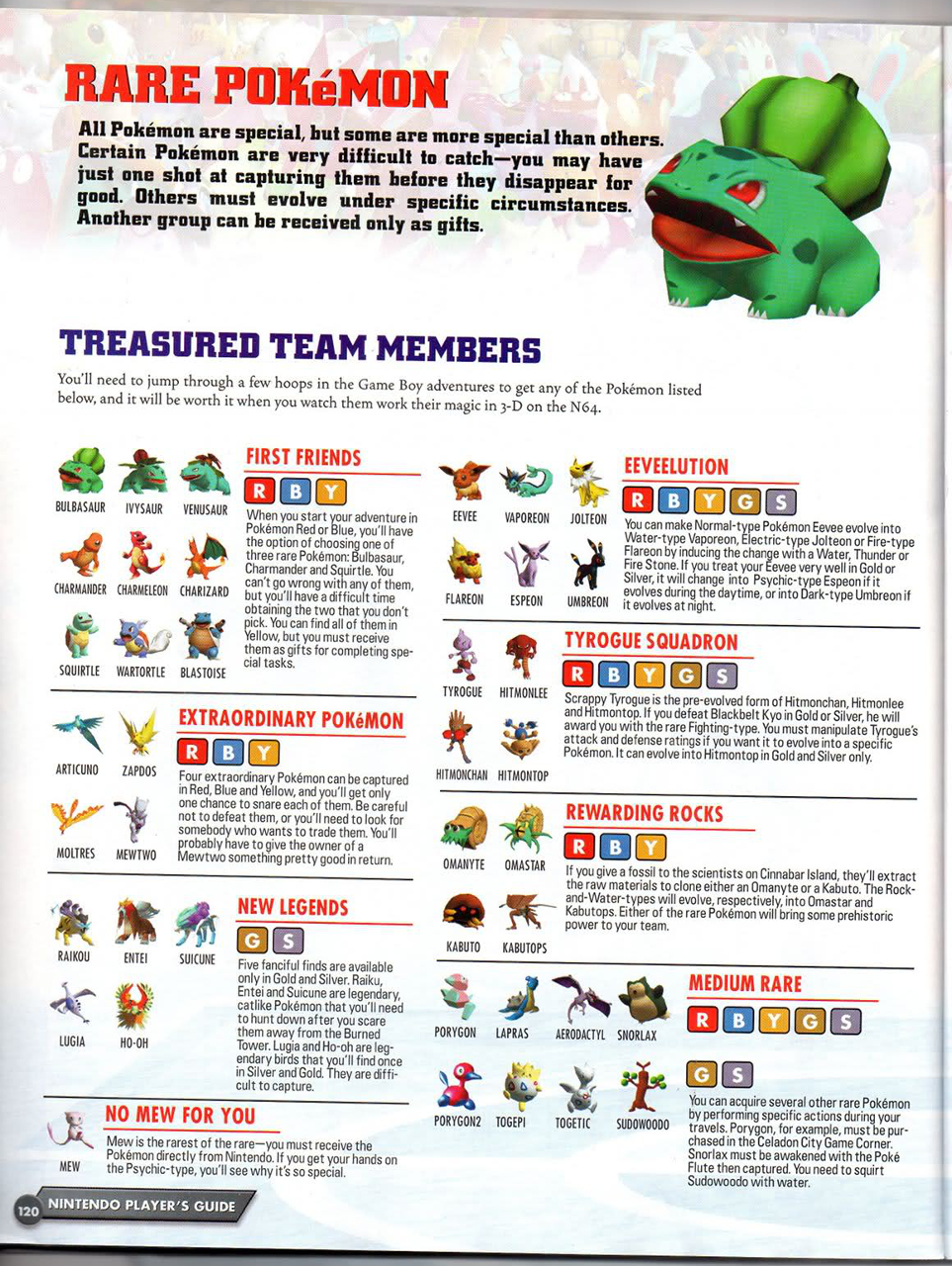
Hitmonlee, Hitmonchan, Hitmontop, and sometimes Tyrogue. They are also referred to as the Tyrogue squadron.[1]
Kasekimera
- Main article: Fossil → Generation VIII
(Japanese: カセキメラ Kasekimera) is used within the Japanese fandom to collectively refer to Fossil Pokémon introduced in Generation VIII: Dracozolt, Arctozolt, Dracovish, and Arctovish. The term is derived from the Japanese word 化石 kaseki (fossil) and the English word chimera.
Legendary group
- Main article: Groups of Legendary and Mythical Pokémon
A group of Legendary Pokémon. The most common groupings include Legendary duo and Legendary trio.
Legendary duo
A group of two Legendary or Mythical Pokémon that share some association.
Eon duo
- Main article: Eon duo
Latios and Latias. Often referred to collectively as Lati@s.
Legendary trio
A group of three Legendary or Mythical Pokémon that share some association.
Weather trio
- Main article: Super-ancient Pokémon
Kyogre, Groudon, and Rayquaza. They are officially referred to as the super-ancient Pokémon.
Trio master
A Legendary Pokémon that is associated with and regarded as superior to (in in-universe lore) the members (or other members) of a Legendary trio.
Mew variants
A subset of Mythical Pokémon. Each of their base stats are 100 with a base stat total of 600, and share the same EV yield, with 3 HP EVs when defeated. They are available only as event Pokémon. Includes Mew, Celebi, Jirachi, Manaphy, Shaymin, and Victini. Sometimes referred to as pixies or Mythical fairies, although the latter is also used to describe the lake guardians.
Novelty Pokémon
Also known as gimmick Pokémon, a Pokémon that possesses a unique trait, usually in battle. Pokémon most often to be considered novelty are: Magikarp, Ditto, Eevee, Porygon, Unown, Wobbuffet, Shuckle, Smeargle, Wurmple, Slaking, Shedinja, Plusle with Minun, Spinda, Castform, Kecleon, Deoxys, Burmy, Cherrim, Rampardos, Gastrodon, Rotom, Arceus, Darmanitan, Zoroark, Sawsbuck, Accelgor with Escavalier, Keldeo, Meloetta, Genesect, Ash-Greninja, Vivillon, Aegislash, Zygarde, Oricorio, Wishiwashi, Pyukumuku, Minior, Komala, Mimikyu, Necrozma, Cramorant, Toxtricity, Eiscue, Morpeko, Palafin, and Dondozo with Tatsugiri.
Pseudo-legendary Pokémon
- Main article: Powerhouse Pokémon
A Pokémon that has a three-stage evolutionary line, 1,250,000 experience at level 100, and a base stat total of exactly 600. Includes Dragonite, Tyranitar, Salamence, Metagross, Garchomp, Hydreigon, Goodra, Kommo-o, Dragapult, and Baxcalibur. They are officially referred to as Powerhouse Pokémon.
Shalpha
A portmanteau of "Shiny" and "Alpha" or short for Shiny Alpha Pokémon. This term refers to alpha Pokémon that are also Shiny, which can be found in Pokémon Legends: Arceus and Pokémon Legends: Z-A.
Shillmon
"Shillmon", "designated shillmon", or "industry plant", are community-driven slang terms used by Pokémon fans to describe Pokémon that receive disproportionate exposure, marketing focus, and perceived favoritism from The Pokémon Company, Game Freak, or anime producers. These Pokémon are often heavily merchandised, prominently featured in the anime, or given special roles in spin-off titles such as Super Smash Bros. or Pokkén Tournament.
Pokémon labeled as shillmons often share common design traits, most notably humanoid or semi-humanoid forms with animalistic, "furry", features. Such designs tend to be more popular than purely animalistic or object-based Pokémon, likely due to greater relatability. This is particularly visible in the final evolutions of some starter Pokémon, which frequently adopt humanoid proportions seemingly intended to maximize appeal. Some Pokémon gain high exposure due to Generation I nostalgia or organic popularity without deliberate promotion. These are usually excluded from the shillmon label, as they are not perceived as being intentionally engineered for popularity or given unusual preferential treatment.
- Lucario is widely considered the defining example of a shillmon. It was revealed long before most Generation IV Pokémon, allowing it to gain popularity through novelty. Lucario starred in Lucario and the Mystery of Mew, a role typically reserved for legendary or mythical Pokémon, elevating its status beyond that of a standard species. Its humanoid, furry-inspired design, combined with the concept of aura, psychic-like abilities, exceptional strength, and a strong bond with its trainer, led many fans to view Lucario as deliberately engineered for mass appeal. Later it was given two Mega Evolved forms.
- A similar approach appeared in Generation V with Zoroark, which benefited from being the first Pokémon of its generation revealed. It received its own movie, featured a humanoid yet bestial and "edgy" design, and introduced the unique ability Illusion, all of which reinforced its marketing prominence.
- In Generation VI, Greninja is commonly viewed as the shillmon of the era. In the anime, it formed a unique bond with Ash, granting it a special form comparable to Mega Evolution. This form initially did not exist in the games, giving Greninja an aura of mystery until its later introduction. Regular Greninja was also given the powerful ability Protean, greatly boosting its competitive value. Its humanoid body plan, dark color scheme, and ninja theme further enhanced its appeal.
- In Generation VII, Dusk Form Lycanroc is sometimes cited due to its surprise introduction, werewolf-inspired design, and association with Ash. However, Zeraora, a highly humanoid, beast-like mythical Pokémon that received its own movie, is more frequently included in shillmon discussions.
- In Generation VIII, Cinderace is widely regarded as fitting the shillmon trope. It achieved high popularity, was assigned to Goh in the anime, and received the ability Libero, functionally identical to Protean. Its fully humanoid design portrays it as a soccer player, a globally popular and marketable theme.
- In Generation IX, Meowscarada continues this trend. It completes the trio with Greninja and Cinderace by receiving Protean. Although it begins as a quadrupedal cat Pokémon, its final evolution adopts a humanoid form with a Dark typing and an illusionist theme, reinforcing recurring design and marketing patterns associated with shillmons.
Notably, Pokemon from older generations like Charizard, Mewtwo, and Absol might have also be mentioned as shillmons.
Sub-Legendary Pokémon
Legendary Pokémon that are permitted in battle facilities and usually permitted in official tournaments. These Pokémon (besides Generation VI) include:
- Articuno
- Zapdos
- Moltres
- Raikou
- Entei
- Suicune
- Regirock
- Regice
- Registeel
- Latias
- Latios
- Uxie
- Mesprit
- Azelf
- Heatran
- Regigigas
- Cresselia
- Cobalion
- Terrakion
- Virizion
- Tornadus
- Thundurus
- Landorus
- Type: Null
- Silvally
- Tapu Koko
- Tapu Lele
- Tapu Bulu
- Tapu Fini
- Kubfu
- Urshifu
- Regieleki
- Regidrago
- Glastrier
- Spectrier
- Wo-Chien
- Chien-Pao
- Ting-Lu
- Chi-Yu
- Okidogi
- Munkidori
- Fezandipiti
- Ogerpon
A list in the data since Pokémon Sun and Moon, named "sublegend" in the game code, grouped the Ultra Beasts with all of the sub-Legendary Pokémon, despite them not being Legendary Pokémon. This grouping continued until Pokémon Scarlet and Violet, in which Ultra Beasts are no longer grouped under this "sublegend" list.
Legendary Pokémon that are not sub-Legendary Pokémon are officially known as Special Pokémon.
Type triangle
A trio of types where one beats another and loses to another, such as Water-Grass-Fire or Dark-Fighting-Psychic, the former notably used for first partner Pokémon. Both the Dragon and Ghost types can create type triangles by themselves only. The Normal type is the only type that is not super effective against any type, but weak against the Fighting type. All single type triangles go as follows:
| ← | Type 1 | ← | Type 2 | ← | Type 3 |
|---|---|---|---|---|---|
| Perfectly balanced | |||||
| ½× | 
|
½× | 
|
½× | 
|
| ½× | 
|
½× | 
|
½× | 
|
| ½× | 
|
½× |
|
½× |
|
| ½× | 
|
½× |
|
½× | 
|
| 1× |
|
1× |
|
1× | 
|
| Unilaterally balanced | |||||
| ½× |
|
1× |
|
1× |
|
| ½× |
|
1× |
|
1× |
|
| ½× |
|
1× |
|
1× |
|
| ½× |
|
1× |
|
1× |
|
| ½× |
|
1× |
|
1× | 
|
| ½× |
|
½× |
|
1× |
|
| ½× | 
|
½× |
|
1× |
|
| ½× |
|
½× |
|
1× |
|
| ½× |
|
½× |
|
1× |
|
| ½× |
|
½× | 
|
0× | 
|
| 1× |
|
1× |
|
0× | 
|
| Outdated (only for Generation I) | |||||
| 2× |
|
1× |
|
1× |
|
| 1× |
|
1× |
|
1× |
|
Fan terms
Aslowla
Refers to the Pokémon introduced in Generation VII being unfitted in design due to their typically low Speed stat (usually 70 base Speed or lower), such as Decidueye and Vikavolt. The term originates from GameFAQs and derives from a portmanteau of the Alola region and "slow".
A similar term is "the Hoenn Special", referring to Pokémon with equally or similarly high Attack and Special Attack stats, but mediocre Defense, Special Defense and Speed. So-named because several Pokémon introduced in Hoenn, such as Camerupt, Cacturne and Seviper have this stat distribution. Although the more generic term "slow-frail mixed attacker" is also used, "the Hoenn Special" is also often applied to Pokémon introduced in later generations with similar distribution, such as Scovillain, usually to make a point that such a stat distribution is "anachronistic".
Dexit
A term referring to the controversy surrounding Game Freak's announcement that some Pokémon would not be usable in Pokémon Sword and Shield. Derives from a portmanteau of "Pokédex" and "Brexit", a debate between UK citizens concerning whether the UK (which is the basis of Galar, the setting of Sword and Shield) should leave the European Union.
Genwunner
A pejorative term used to describe fans who dislike elements of the Pokémon franchise released after Generation I (and, to a lesser extent, Generation II). A corruption of "Generation One". Originated from the Transformers fandom's term of "Geewun", where some fans have a similar stance on said franchise. However, fanon terms relating to other generations in the franchise (such as Generations III or IV) are less often used.
Hoenn trumpets
Refers to the typical sound of instruments used in the OST (original soundtracks) of Ruby, Sapphire, and Emerald in the Hoenn region.
Pokégirl
A term used to refer to any female character in the Pokémon franchise. Derives from a portmanteau of "Pokémon" and "girl".
Smugleaf/Weed Cat
Refers to the infamous nickname of Snivy and Sprigatito, respectively. The former is infamously used prior the reveal of Snivy's English name due to the Generation V games being not released simultaneously in worldwide.
Wottergate
Refers to fans' reactions to the leak revealing the final Evolution of the Unova starters, most notably the drastic shift in Oshawott's evolutionary line. While Oshawott and Dewott are bipedal, their final Evolution, Samurott, is quadrupedal, which many fans found jarring. The term is a portmanteau of "otter" and "Watergate", referencing the major U.S. political scandal.
Zero Crew
Zero Crew, or sometimes Zerocrew, is the colloquial term given to the friend group consisting of Nemona, Arven, and Penny in Pokémon Scarlet and Violet. The term derives from the fact that all three officially met each other in Area Zero.
Game terms
Battle Gimmick
Battle Gimmick is a collective term for special battle mechanics that take center stage in battles and often play a major role in the story. Alternatively they can be called regional phenomena[citation needed]. Starting with Generation VI, each generation introduces one such gimmick, usually replacing the previous one. These include: Mega Evolution (sometimes alongside Bond Phenomenon and Primal Reversion), Z-Moves (including Ultra Burst), Dynamax (with variants like Gigantamax and Eternamax), and Terastal phenomenon (with Terastallized state). Interestingly, several of these names follow a pattern based on metric prefixes: mega, giga, and tera.
In Pokémon Champions, these are officially referred to as Mechanics when checking battle formats and rules in private battles.
Boss
The general concept of a boss in video games may refer to special, strong opponents who must be defeated to obtain an important reward or advance past a particular point in the game. In the Pokémon games, there are various figures who may fit this description:
- Core games
- Gym Leaders: these are characters the player explicitly has to defeat if they wish to reach the Elite Four. Oftentimes, defeating a particular Gym Leader is also required for the player to advance past certain obstacles, especially those that require the use of an HM.
- Elite Four: the "point" of the core series games is generally to beat the Elite Four, who will be stronger than any other Trainers the player has faced previously.
- Champion: after beating the Elite Four, the player must also defeat the region's Champion in order to be allowed to enter the Hall of Fame.
- Rivals: the player will often cross paths with a rival character, and usually they must face off with this character one last time before being able to face the Elite Four.
- Island kahunas: a group of four Trainers in the Alola region that Trainers will need to defeat to progress in their island challenge. They can be seen as the Alolan equivalent to Gym Leaders.
- villainous organizations in the core games (and many spin-offs) will appear frequently cross paths with the player. In the course of the game, the player will eventually have to defeat various high-ranking members of these organizations and in most cases, their leader. Every organization has different ranking trainer classes, however in most cases, Grunts and Employees are not considered bosses.
- Tower Tycoons, Frontier Brains, Subway Bosses, Boss Trainers, Battle Chatelaines and Battle Legends: these are the leaders of certain special battle facilities presented as an optional challenge once the player has beaten the Champion. Defeating them usually grants the player a special achievement.
- Particular Trainers during promotion and reward matches in the Z-A Royale may be considered bosses, particularly the promotion matches which replace the battling of a Gym Leader in the traditional gym-focused games.
- Legendary and Mythical Pokémon: the player will encounter these later in the game, usually resulting in a boss battle. Many Legendary Pokémon generally have larger base stats compared to usual Pokémon.
- Totem Pokémon are encountered at the end of every trial throughout the island challenge, serving as the boss of each trial.
- Max Raid Battles are co-op battles with a Dynamax or Gigantamax Pokémon, similar to a traditional boss battles as they are fought at various intervals throughout the game. The Eternatus and Eternamax Eternatus battles are stylized after the Max Raid format.
- Noble Pokémon, Origin Forme Dialga/Palkia, and Arceus are encountered in Pokémon Legends: Arceus and need to be quelled through throwing balms at them (while optional, periodic battling makes this easier), this acts similar to a traditional RPG boss fight.
- Alpha Pokémon (who's Japanese name are オヤブン boss), are larger, more powerful, variants of usual Pokémon. The player receives larger rewards for their defeat.
- Titan Pokémon, Starmobiles, the KoraidonS/MiraidonV in Area Zero, the Bloodmoon Ursaluna, Ogerpon, Terapagos and Pecharunt are encountered and possess larger health bars similar to how boss health bars are depicted in most games and in most cases, also possess a title right after their name, such as "Terapagos, the Indigo Disk".
- Tera Raid Battle are co-op battles with a Terastallized Pokémon, similar to a traditional boss battles and Max Raid Battles. The Terpagos fight with Carmine is stylized after this format.
- Rogue Mega Evolution, Hyperrogue Ange Floette, Zygarde, Primal Kyogre, and Primal Groudon are encountered and possess larger health bars similar to how boss health bars are depicted in most games.
- Side games
- Pregymleader Justy: Justy is the leader of the Pre Gym in Pokémon Colosseum and Pokémon XD.
- Area Leaders and Mt BtlMaster: these are the heads of different Mt. Battle areas in Pokémon Colosseum and Pokémon XD.
- Colosseum Leaders, Colosseum Masters, and the Pokétopia Master: these are the heads of Colosseums in Pokémon Battle Revolution.
- Spin-offs
- The Pokémon Mystery Dungeon series has various boss characters at different points in the story:
- Shadow Mewtwo: the opponent in the final battle of the storyline of Pokkén Tournament
- Pokémon Magikarp Jump uses the term "boss" to refer one in every five opponents.
- Pokémon UNITE features a Boss Rush mode, featuring Wild Pokémon that appear in other stages in the game that have a larger health bar than other Wild Pokémon, which are explicitly called Boss Pokémon in this mode.
Collection terms
Living Pokédex
- Main article: Living Pokédex
Having a Pokémon of every species (available in that game) in the Pokémon Storage System at the same time.
Legitimate
A Pokémon or item obtained without cheating or intentional glitch use. Typically this refers to a Pokémon or item obtained through normal gameplay, without any third party modifications to the game's ROM or RAM. Pokémon obtained via RNG Abuse, or via bugs that the player would run into naturally during normal gameplay, (Gen 3's Roamer IV bug for example), are still typically considered legitimate as the game would generate those Pokémon within the bounds of what was possible to obtain naturally, in an unmodified instance of the game.
- Note that Legitimate does not inherently mean Legal, it is possible to encounter Pokémon during normal gameplay that have otherwise impossible attributes, and the The Pokémon Company would consider unauthorized.
- 1★ Wild Area News Drilbur with Hydro Pump is an example of a Pokémon that was legitimately obtainable but considered Illegal, as it was programmed with a game move error. The game does not permit its use online nor official tournaments, and several hours after the mistake was discovered Game Freak had fixed the erroneous Wild Area News data to replace Hydro Pump with the correct move, Scratch.
- These situations are typically handled case-by-case. As a counter example, the 5★ Tera Raid Battle Female Indeedee with the error move Trick Room is not blocked from online use, and in early December 2022 even saw prior restrictions removed, permitting raids with the erroneous move to be hosted online to other players, and later patched the game to allow Female Indeedee to learn Trick Room via TM. In a situation like this, it could be argued the developers consider this error to be both Legal and Legitimate, despite the similar circumstances to the aforementioned Drilbur with Hydro Pump.
- Additionally, the state of the savefile itself is generally not taken into account when determining the legitimacy of an individual Pokémon. Even if the savefile is in an unnatural state via glitches, cheats, save editing, etc., if the generation/encounter conditions of a Pokémon are unaffected, a savefile in an unnatural state can still produce Legal and Legitimate Pokémon.
- As an example, using a glitch that warps the player to an area early, but does not alter the encounter conditions of Pokémon found in that area, would generate Pokémon in an identical manner to a player who arrived in that area under normal gameplay conditions.
Illegitimate
A Pokémon or item obtained via cheating or intentional glitch use. Typically this refers to a Pokémon or item generated via any third party modifications to the game's ROM or RAM, or with the use of intentional glitches to drastically alter the game into a state where it produces Pokémon or items in a way it would never be able to during the course of normal gameplay.
- This term may also be used to refer to event Pokémon generated outside of their typical distribution periods or methods via glitches, Arbitrary code execution, Wonder Card injection, or other exploits such as the DNS Exploit.
- Contrary to the above, several event Pokémon are programmed as in-game static encounters or gifts accessible via activating an in-game event or event-exclusive location (such as Birth Island's Deoxys or Faraway Island's Mew), rather than generated directly by a Wonder Card.
It could be argued that if an encounter is accessed via warp glitches, (on a game version/language the encounter was legitimately obtainable in, i.e. Faraway Island's Mew is only legitimately accessible on Japanese language copies of Pokémon Emerald, accessing it on an English copy of Emerald would result in an Illegal Mew), that since the encounter itself is unmodified and available in the base game, the Pokémon itself could be considered both Legal and/or Legitimate even if the savefile itself is in an unnatural state.
- Contrary to the above, several event Pokémon are programmed as in-game static encounters or gifts accessible via activating an in-game event or event-exclusive location (such as Birth Island's Deoxys or Faraway Island's Mew), rather than generated directly by a Wonder Card.
- Illegitimate Pokémon and items are not limited to just those produced via cheating using third party tools, as Pokémon or items generated directly via cloning glitches or Arbitrary code execution would still fall into this category, even if the result would be considered Legal.
Legal
A Pokémon or item in a state that is possible to achieve through normal gameplay. This means that regardless of what method was used to obtain it, one could obtain this Pokémon in its current state without cheating or intentional glitch use.
- Note that this is not inherently the same as Legitimate. While most Legitimate Pokémon are also Legal, this term only refers to the current state of the Pokémon and whether it could be theoretically obtained in that state through normal gameplay. A Pokémon may still be Legal even if it was obtained through the use of third party modifications, cheats, glitches, etc.
Illegal
A Pokémon or item in a state that is typically impossible to achieve through normal gameplay, and/or is disallowed by The Pokémon Company. This means that regardless of what method was used to obtain it, this Pokémon has at least one value that could only be obtained via cheating, intentional glitch use, or via an oversight by the developers of the game that permitted it to be obtained.
- Note that a Pokémon can still be illegal even if permitted to be used online, having not been detected by the server's anti-cheat detection, as the term refers to the Pokémon itself being in an unobtainable state, not necessarily whether it is detected by the game's anti-cheat.
- Shiny Victini is an example of a Pokémon that is illegal but remains usable online. To date, it has never been obtainable in-game, nor distributed as an event Pokémon in its Shiny form. Despite being a Shiny-locked species, Shiny Victini is not detected by any anti-cheat in Generations V through IX, nor Pokémon Bank or Pokémon HOME.
- It is also possible for illegal Pokémon or items to be obtained, or even generated by players who are not cheating, having only interacted with the game via legitimate means, as a result of interference by other cheating players.
- One such instance would be breeding using a parent Pokémon that has an impossible combination of Poké Ball and species, or impossible Egg moves, obtained via trade from a cheating player.
- Another instance would be a player joining a hacked Max Raid via Y-Comm, (prior to Sword and Shield v1.2.1), and then catching the resulting illegal Pokémon, or receiving an unobtainable item as a reward for defeating it. As a result, Pokémon and items that were impossible to receive via trade due to anti-cheat detection were made possible to obtain on an unmodified savefile, as the Pokémon and items are generated client-side by the non-cheating participant's game.
Untouched
A Pokémon that is in the same state as it was obtained in. Specifically, it has gained no experience, levels, EVs, or Ribbons, had none of its moves changed or reordered, and has not evolved, gained Pokérus, or had its pre-existing Pokérus become inactive. Commonly used to refer to event Pokémon and in-game gift Pokémon.
Balltism
A term used by collectors to describe catching Pokémon with a specific type of Poké Ball. Often, this involves a desire to have the Ball's color scheme, thematic properties, or release animation align with the Pokémon it contains, as well as unique or unlikely combinations being valued. Some examples commonly sought after by players are Pokémon obtained in Apriballs (which in most main series games are rare, or difficult to obtain), and non-Ultra Beast species being obtained in Beast Balls (due to the drastically lower 0.1× catch rate when used on non-Ultra Beast species).
The word is a portmanteau of "Ball" and "Autism",[citation needed] sometimes used as a pejorative term in reference to one's obsession with obtaining a given Pokémon in a specific type of Ball, or devaluing Pokémon deemed to be in a "non-matching" type of Ball.[2]
On April 24, 2021, the merchandise line "BALL FREAK", which prominently featured the concept of matching Pokémon and Poké Balls of similar style/coloration, released on the Japanese Pokémon Center website;[3] however, this terminology hasn't appeared in any other media. It's currently unclear if The Pokémon Company considers "ball freak" an official term for the concept, or if it was only intended for use as a title for the specific merchandise line. To date, this remains the only official reference to this concept.
Game acronyms
Most of the Pokémon games come in pairs and are often followed by enhanced versions, hence Pokémon fans call them collectively with the first letters of their names.
Some of these are coined by fans, while others are derived from official sources, such as internal files.
- RGBY: Pokémon Red, Green, Blue, and Yellow. Sometimes only RBY, omitting the Japanese exclusive Pokémon Green in favor of its international release, Pokémon Blue.
- GSC: Pokémon Gold, Silver, and Crystal
- RSE: Pokémon Ruby, Sapphire, and Emerald
- FRLG: Pokémon FireRed and LeafGreen
- DPPt: Pokémon Diamond, Pearl, and Platinum. Sometimes DPP or DPt.
- HGSS: Pokémon HeartGold and SoulSilver
- BW: Pokémon Black and White
- B2W2: Pokémon Black 2 and White 2. Sometimes BW2.
- XY: Pokémon X and Y
- ORAS: Pokémon Omega Ruby and Alpha Sapphire
- PoGO: Pokémon GO
- SMUSUM: Pokémon Sun, Moon, Ultra Sun, and Ultra Moon. Can be split respectively into SM for Sun and Moon, and USUM or USM for Ultra Sun and Ultra Moon. Sometimes SuMo is seen for Sun and Moon only.
- LGPE: Pokémon: Let's Go, Pikachu! and Let's Go, Eevee!. Sometimes PE, LPE, or LPLE.
- SwSh: Pokémon Sword and Shield. Capitalization can vary between SwSh and SWSH. Sometimes SS.
- IoA: Pokémon Sword and Shield: The Isle of Armor
- CT: Pokémon Sword and Shield: The Crown Tundra
- BDSP: Pokémon Brilliant Diamond and Shining Pearl
- LA: Pokémon Legends: Arceus. Sometimes PLA or PL:A.
- SV: Pokémon Scarlet and Violet. Sometimes ScVi or ScarVio.
- HToA0: Scarlet and Violet: The Hidden Treasure of Area Zero. Used when referring to the pair of DLCs, rather than the individual releases. Sometimes HToAZ.
- TTM: Scarlet and Violet: The Teal Mask. Includes the initial "The" in the acronym to avoid confusion with TM for Technical Machine.
- TID: Scarlet and Violet: The Indigo Disk. Sometimes ID, dropping the initial "The" in an attempt to avoid confusion with Trainer ID, which also uses the acronym "TID".
- HToA0: Scarlet and Violet: The Hidden Treasure of Area Zero. Used when referring to the pair of DLCs, rather than the individual releases. Sometimes HToAZ.
- ZA: Pokémon Legends: Z-A. Sometimes Z-A, PLZA, PL:ZA, or L:ZA.
- WiWa: Pokémon Winds and Waves. Sometimes WW.
- Champs: Pokémon Champions. Sometimes CP or CHP.
Gameplay terms
6IV or 6V
Refers to either a Pokémon with individual values of 31 for all 6 stats, or a Pokémon with all 6 stats set to "competitively viable" values. This is also commonly referred to as "perfect IVs".
- As an example, some competitive strategies require a Pokémon to have an intentionally lower stat, such as an IV of 0 for Attack, or Speed. Strategies using Trick Room or Gyro Ball may benefit from a Pokémon having a lower Speed stat than the opponent, therefore a Pokémon with IVs of 31 in every other stat, but with a Speed IV of 0, may still sometimes be referred to as 6IV or "perfect".
The term "5IV" or "5V" (a Pokémon with IVs of 31 in only five stats) is also commonly used due to the breeding effect of Destiny Knot introduced in Generation VI, allowing for the value of 5 random IVs of a bred Pokémon to be inherited from the parents if either parent holds the Destiny Knot.
Chaining
A method used to repeatedly encounter the same Pokémon via a feature such as Poké Radar and DexNav, which lines up the chance of getting a desired Pokémon. Chaining with the Poke Radar is often tried for the purposes of getting a Shiny Pokémon of a specific species.
Cheating
- Main article: Cheating
The use of any device unauthorized by The Pokémon Company to modify a Pokémon game. Being found to have cheated in any way, or having a Pokémon that was obtained by cheating on another game will result in immediate disqualification from any official tournament, and disqualification from all future official tournaments.
EV training
Intentionally battling Pokémon for the EVs they give out in order to ensure EVs are distributed in a specific way or capped.
Focus Miss/Stone Miss/Will-O-Miss
Derogatory terms for Focus Blast, Stone Edge, and Will-O-Wisp, referring to the moves' mediocre accuracy.
Gear Station or Centrico Plaza trick
Securing the D-pad or analog stick in one direction so that the player continuously walks around the circular Gear Station or Centrico Plaza, resulting in an effortless refilling of Hidden Grottoes, increase in friendship, hatching of Eggs, and accumulation of Poké Miles.
Grinding
Training a Pokémon to a certain level through repetitive battling.
Hatcher
A Pokémon with the Ability Flame Body, Magma Armor, or Steam Engine such as Fletchinder, Slugma, and Rolycoly in the party, mainly used for hatching Eggs faster.
HM mule

A term used within parts of the fandom to refer to a Pokémon in a Trainer's party that is used for navigational support through the use of field moves—generally those taught by Hidden Machines. HM mules will typically have three or four move slots occupied with field moves, allowing smooth passage through caves, across oceans, or past other obstacles at the expense of their battling capabilities.
With the retirement of HMs and field moves from Generation VII onward, HM mules are not necessary in those games. In Generation VII, the functions of HMs are replaced by Poké RidesSMUSUM and Secret TechniquesPE. In Pokémon Sword and Shield, the Rotom Bike's Water Mode replaces Surf and the Flying Taxi replaces Fly. In Pokémon Brilliant Diamond and Shining Pearl, HM functions can be accessed through the Pokétch, though certain other field moves (such as Flash) are used by a party Pokémon as in the original games. In Pokémon Legends: Arceus, various ride Pokémon provide similar functions, allowing the player to traverse through Hisui faster, swim through water, climb steep cliffs, and glide through the air. The Arc Phone's map allows players to warp between locations, replacing Fly. In Pokémon Scarlet and Violet, traversal abilities are gained by the player's KoraidonS/MiraidonV during the Path of Legends storyline, and the Flying Taxi from Sword and Shield returns.
HM mules are often referred to as HM slaves, HM friends or even HMployee. An equivalent term used within the Japanese fandom is 秘伝要員, with 秘伝 being from 秘伝マシン Hidden Machine followed by 要員 personnel.
HSOWA

The fan term HSOWA is an initialism that stands for "Hot Skitty On Wailord Action". It is derived from the fact that Skitty and Wailord can breed in the games despite their massive size difference. It has reached cult status on some message boards. The term originates from GameFAQs.
IV breeding
Intentionally breeding Pokémon to have a specific IV or set of IVs.
Masuda method
- Main article: Masuda method
The game mechanic that increases the likelihood of Shiny Pokémon to hatch from Eggs if the parents are from differing real-world geographical locations. Named after Junichi Masuda, who first documented this mechanic in his blog.
Nuzlocke Challenge
- Main article: Nuzlocke Challenge
A special challenge playthrough of a Pokémon game in which the player must follow a set of self-enforced rules to make the game more difficult. Most notably, the player can only catch the first Pokémon they encounter on each route, and must release any Pokémon that faints. Named after the comic series of the same name that first proposed the type of playthrough.
Professor Oak Challenge
A time-consuming challenge playthrough of a Pokémon game in which the player must fill up the Pokédex as much as possible before obtaining each badge (or completing an equivalent boss fight in games without badges). This challenge was created by user Chamale on Reddit[4], and popularized by Johnstone on YouTube.
Repel trick
- Main article: Appendix:Repel trick
Using Repels and a lead Pokémon of a specific level to restrict wild Pokémon encounters to a specific Pokémon or group of Pokémon due to the maximum level at which wild Pokémon can appear.
Shiny-locked
- Main article: List of unobtainable Shiny Pokémon
Referring to a Pokémon obtained in a particular game that is prevented from being Shiny.
Spinners
NPC Trainers that randomly change the direction they face. Avoiding battles with them is key to speedruns.
Spinner trick
Securing the D-pad or analogue stick in a single direction so that the player continuously walks into a spin tile, resulting in an effortless increase in friendship and hatching of Eggs. Often called the "Fuego trick" in Pokémon Diamond, Pearl, and Platinum due to Fuego Ironworks being the optimal location for doing so.
Synchronizer
Pokémon with the Ability Synchronize such as Abra and Ralts in the first place in the party, mainly used for obtaining Pokémon with the desired Nature.
Walking Pokémon
- Main article: Walking Pokémon
Pokémon that walk alongside their Trainer when they normally would be inside their Poké Balls outside of battle. Also referred to by fans as Pokémon following you.
Apriball
- Main article: Apricorn
Referring to the Poké Balls crafted using Apricorns in Johto, KantoHGSS, or Galar regions, specifically the Heavy, Lure, Friend, Love, Level, Fast, and Moon Balls.
Despite Poké Balls in Pokémon Legends: Arceus also being craftable using Apricorns, this term doesn't refer to Poké Balls from the Hisui region.
Metagame terms
- Main article: Appendix:Metagame terminology
Technical terms
EVs
- Main article: Effort values
Effort values, often shortened to EVs and officially known as base points, are capped permanent stat bonuses gained by defeating Pokémon, using items such as vitamins or wings, or using services such as those in Join Avenue. They ensure trained Pokémon are stronger than newly caught Pokémon.
AVs
- Main article: Go Power
Awakening values, often shortened to AVs and officially known as Go Power, are used in Pokémon: Let's Go, Pikachu! and Let's Go, Eevee! in place of EVs. AVs are used to increase a Pokémon's stats, but are awarded through the use of Candy and leveling up, rather than by defeating other Pokémon in battles or consuming vitamins.
ELs or GVs
- Main article: Effort level
Effort levels, often shortened to ELs, (referred to internally as "Ganbaru values", often shortened to GVs), are a mechanic introduced in Pokémon Legends: Arceus. Effort levels take the place of effort values from previous games. Pokémon gain effort levels through the use of Grit items, but will initially begin with 0-3 ELs in each stat, with the amount being determined by the Pokémon's IVs.
IVs
- Main article: Individual values
Individual values, often shortened to IVs, are fixed values that can be inherited from the Pokémon's parents. They ensure Pokémon are genetically different.
PID or EC
- Main article: Personality value
A shortened version of the term personality value, a hidden value used to determine several properties of a Pokémon, including Shininess. Generation VI onwards, this value is split into two separate values, with the latter being referred to as the Encryption Constant, often shortened to EC.
PSV or ESV
Pokémon Shiny Value, often shortened to PSV, and Egg Shiny Value, often shortened to ESV, are values derived from a Pokémon or Egg's personality value, designed as an easy way to tell if the Pokémon or Egg will appear as Shiny for a given player, if the value is the same as that player's Trainer Shiny Value, (often shortened to TSV).
TID or SID
- Main article: Trainer ID number
Trainer ID, often shorted to TID, is the 5 to 6 digit value displayed on the player's Trainer Card, League Card, or in-game save menu. The Secret ID, often shortened to SID, is a hidden 4 or 5 digit value used alongside the Trainer ID to determine which Pokémon will appear as Shiny for the player, according to the Pokémon's personality value.
TSV
Trainer Shiny Value, often shortened to TSV, is a value derived from the player's Trainer ID and Secret ID, designed as an easy way to tell if a given Egg or Pokémon will be Shiny for the player, if their Egg Shiny Value, (often shortened to ESV), or Pokémon Shiny Value, (often shortened to PSV) is the same value as the player's Trainer Shiny Value.
RNG or RNG Abuse
- Main article: Pseudorandom number generation
Refers to the Random Number Generator, or the practice of manipulating it through the use of fan-made software (commonly referred to as RNG Abuse), in order to obtain Shiny Pokémon or Pokémon with specific IVs—both endeavors which would otherwise leave a lot up to chance.
Spin-off game terms
Charmer
Refers to any Pokémon, usually Fairy-type Pokémon, with Charm as its Fast Move in the Pokémon GO competitive battle. Examples of charmers are Clefable, Wigglytuff, Gardevoir, Togekiss, and Primarina.
Hundo/Shundo
Hundo (from "hundred percent" or "100%") refers to Pokémon with individual values of 15 for all of its 3 stats (HP, Attack, and Defense) in Pokémon GO, which is similar to the "6V/6IV" or "perfect IVs" in the core series. Shundo refers to a Pokémon that is both hundo and Shiny.
Jungle/Jungler
Jungle refers to the central area of a stage in Pokémon UNITE. Pokémon that are taken to the central area at the beginning of the match are referred to as junglers. This term comes from other multiplayer online battle arena games, where it is used to refer to areas that contain a large number of enemies that can be defeated to gain a large amount of experience points and receive temporary buffs.
Mudboi
Refers to any Water/Ground-type Pokémon with Mud-Slap or Mud Shot as its Fast Move in the Pokémon GO competitive battle. Examples of mudbois are Quagsire, Swampert, Whiscash, and Gastrodon.
Animation terms
Ashnime/Likonime
These terms refer to the two main animated series: Ashnime refers to Pokémon the Series, whereas Likonime refers to Pokémon Horizons: The Series.
Pokémon Trading Card Game terms
These terms are typically derived from and used by the Pokémon Trading Card Game player base, rather than official sources. Many of these terms were originally used for Magic: The Gathering, another trading card game which the Pokémon TCG draws many design parallels from.
Baby
Not to be confused with baby Pokémon, "baby" refers to a non-Rule Box card being contrasted with one with a Rule Box. For example, the Blacephalon archetype may be referred to as running baby Blacephalon alongside Blacephalon-GX.
BDIF
Short for "Best Deck In Format".
Control deck
A deck archetype whose purpose is to control the opponent's options, typically in such a way that stops them from performing their own deck's strategies. Sometimes known as a "stall deck", as the archetype's goal isn't to reach a victory condition but rather to stall the opponent and run them out of their resources. Examples of control decks include Snorlax Stall.
Deck out
Having no cards in the deck. A player that decks out and is unable to draw a card at the beginning of their turn automatically loses the game.
Donk
Winning on the first turn of the game, typically by Knocking Out the opponent's Active Pokémon when they have no Benched Pokémon for backup.
Gust
Switching an opponent's Benched Pokémon to the Active Spot. Named after the Trainer card Gust of Wind.
Lock
Effects that prevent the opponent from playing certain cards (e.g. Item lock) or making use of cards in play (e.g. Ability lock).
Mill
Discarding cards from the top of the player's or the opponent's deck. Named after the Magic: The Gathering card "Millstone".
A deck that focuses on milling the opponent is known as a "mill deck". In the Pokémon Trading Card Game, this is a viable winning strategy, as a player who can't draw a card from their deck at the start of their turn automatically loses the game. The equivalent Japanese term is LO, short for ライブラリアウト Library Out — "library" is the Magic: The Gathering term for a deck. Note that "LO" in Japan sometimes also refers to control or stall decks.
Scoop
To concede a match, referring to the act of picking up and tidying all the cards on the player's table during a match. Not to be confused with cards that let the player put a Pokémon in play into their hand.
Tech
A card that isn't part of a deck's main strategy, but is included to improve the deck's chances against specific bad matchups.
Toolbox
Unlike decks that focus on a specific primary attacking Pokémon, a "toolbox" or "box" deck includes many different Pokémon in order to target specific matchups in the meta. Examples of toolbox decks include Joltik Box and Tera Box.
The equivalent Japanese term is バレット Bullet, derived from the similar concept of "silver bullet" decks in Magic: The Gathering.
Tutor
To "tutor" a card means to search that specific card from the deck. Named after the Magic: The Gathering card "Demonic Tutor", which lets the player search their deck for any card.
References
- ↑ Pokémon Stadium 2 Nintendo's Player Guide
- ↑ https://gamerant.com/pokemons-quick-ball-controversy-shiny-hunting-look-reversal/
- ↑ https://www.pokemon.co.jp/goods/2021/04/210409_to01.html
- ↑ Final update - I filled the Pokédex in Crystal Version as much as possible without trading or glitches. My legendaries easily defeated Red's high-level team. (Links to previous posts in comments) | u/Chamale, r/pokemon, Jun 29, 2018

|
This article is a part of Project Fandom, a Bulbapedia Project that aims to write comprehensive articles on every aspect of the Pokémon Fandom. |