This article is about the pair of icy islands in the south of the Kanto region. For the animated series-exclusive resort island with a similar name in the dub, see Seafoam Island (anime).
This article is missing one or more images. Please feel free to add any missing images to this article. Needed images can be uploaded to the Bulbagarden Archives. Reason: LGPE layout image
Seafoam Islands
双子島 Twins Island
"Wild Missingno. appeared!"
Seafoam Islands in {{{variable2}}}.
Map description
A pair of islands that is situated on Route 20. The two islands are shaped the same, as if they were twins.FRLG Two small islands lightly floating in the ocean.HGSS Two small islands lightly floating in the ocean. A shocking cold fills the caverns inside.PE
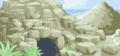
The Seafoam Islands (Japanese: 双子島Twins Island) are a pair of islands (one island in the Japanese versions of the games and other media) that are situated on Route 20 in Kanto. The two islands are shaped the same, as if they were twins.
In the Japanese versions of the Generation I games and Pokémon FireRed, LeafGreen, Let's Go, Pikachu!, and Let's Go, Eevee!, a Picnicker on Route 20 states that the Seafoam Islands used to be two islands, implying that they are currently considered a single island, which is consistent with the games depicting one continuous landmass at high tide. This is also consistent with how they are portrayed in Pokémon Adventures and in Pokémon the Series. However, in the English versions, the Picnicker's line is changed to state that the Seafoam Islands used to be a single island.
In early guidebooks, this has also been referred to as Seafoam Island.[1]
Geography
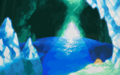
The caves beneath the islands are full of twists and turns and have five separate floors. To complete the trek through them, a series of puzzles
which involve using StrengthRBYFRLGHGSS or Strong PushPE to move boulders to block the flow of water, as the current is too fast to SurfRBYFRLGHGSS or Sea SkimPE across, need to be solved. Any attempt to Surf/Sea Skim on the currents will result to being sent back to where the current ends each time, and it is impossible to fight the currents. When the puzzle is solved, the boulders will stay in the water permanently.
The Seafoam Islands is roost of the Legendary PokémonArticuno. It is located on the lowest floor of the caverns under the islands. It is also where Misty comes to train. In Generations II and IV, the Cinnabar Gym has been relocated here after the original Gym was destroyed by a volcanic eruption on Cinnabar Island.
A colored background means that the Pokémon can be found in this location in the specified game. A white background with a colored letter means that the Pokémon cannot be found here.
A colored background means that the Pokémon can be found in this location in the specified game. A white background with a colored letter means that the Pokémon cannot be found here.
A colored background means that the Pokémon can be found in this location in the specified game. A white background with a colored letter means that the Pokémon cannot be found here.
A colored background means that the Pokémon can be found in this location in the specified game. A white background with a colored letter means that the Pokémon cannot be found here.
A colored background means that the Pokémon can be found in this location in the specified game. A white background with a colored letter means that the Pokémon cannot be found here.
A colored background means that the Pokémon can be found in this location in the specified game. A white background with a colored letter means that the Pokémon cannot be found here.
A colored background means that the Pokémon can be found in this location in the specified game. A white background with a colored letter means that the Pokémon cannot be found here.
A colored background means that the Pokémon can be found in this location in the specified game. A white background with a colored letter means that the Pokémon cannot be found here.
A colored background means that the Pokémon can be found in this location in the specified game. A white background with a colored letter means that the Pokémon cannot be found here.
A colored background means that the Pokémon can be found in this location in the specified game. A white background with a colored letter means that the Pokémon cannot be found here.
A colored background means that the Pokémon can be found in this location in the specified game. A white background with a colored letter means that the Pokémon cannot be found here.
A colored background means that the Pokémon can be found in this location in the specified game. A white background with a colored letter means that the Pokémon cannot be found here.
A colored background means that the Pokémon can be found in this location in the specified game. A white background with a colored letter means that the Pokémon cannot be found here.
A colored background means that the Pokémon can be found in this location in the specified game. A white background with a colored letter means that the Pokémon cannot be found here.
A colored background means that the Pokémon can be found in this location in the specified game. A white background with a colored letter means that the Pokémon cannot be found here.
A colored background means that the Pokémon can be found in this location in the specified game. A white background with a colored letter means that the Pokémon cannot be found here.
A colored background means that the Pokémon can be found in this location in the specified game. A white background with a colored letter means that the Pokémon cannot be found here.
A colored background means that the Pokémon can be found in this location in the specified game. A white background with a colored letter means that the Pokémon cannot be found here.
In Pokémon HeartGold and SoulSilver, while Blaine's Gym is still located in the east cave, Articuno can be found here as it was in Generations I and III. As soon as the player walks into the east cave, there is a ladder that leads to an upper level where Blaine's Gym is located. There is also a set of stairs leading to a lower level in the islands just past the ladder. The Gym is much bigger than its Generation II counterpart as it sports a brand-new puzzle with junior Trainers. The interior of the island received a massive redesign as well; the puzzles involving using Strength to push boulders into holes to block the water currents are gone, and there are instead puzzles where the player must navigate slippery ice fields. The cave section of Seafoam Islands uses the same music as Johto dungeons such as Ice Path, as opposed to the music used in Kanto dungeons. Also, unlike previous generations, there are three Trainers within the islands; two Boarders and one Skier.
In the dub, the recurring location Seafoam Island (Japanese: ビンヌBinnes) derives its name from the Seafoam Islands. However, this beach resort has no relation to the icy Seafoam Islands that appears in the games.
In Battling in the Freezing Raid!, Ash and Goh visited the Seafoam Islands to find an Articuno, which Goh needed to face in a Raid Battle to clear a Project MewTrial Mission. Along the way, they encountered Horace and Gary, who joined them in the Raid Battle once Articuno was found. While they were unable to defeat Articuno, they fared well enough to pass the mission.
The Seafoam Islands first appeared in You Know... Articuno, where Red arrived there with Misty. He then traded his Krabby for her Gyarados, after which Misty left on her Starmie. Later, while walking on the island, Red and his Pokémon spotted Team Rocket members attempting to capture Articuno. Red fought against their Muk, but in the middle of the fight, his new Gyarados's past trauma of being experimented by Team Rocket caused it to go out of control. This gave Muk an opening to attack Red, until it was frozen by Articuno to save him. With Gyarados calming down as well, Red considered the battle won. However, unbeknownst to him, Articuno had spent so much energy to save him that Team Rocket succeeded in capturing it soon afterwards.
In Extricated from Exeggutor, Yellow briefly stopped at Seafoam Islands while crossing the sea with Pika. During her brief stay, she encountered a wild Farfetch'd, which was having trouble finding its nest in a forest. Eventually it turned out that the "forest" was actually just a mass of migrating Exeggutor and Oddish. Yellow then called Professor Oak, who told her that the unnatural migration was likely a sign of the Pokémon sensing an upcoming disaster, foreshadowing the Elite Four's attack on the Kanto region.
The Seafoam Islands appeared in PZ08. Satoshi first passed by them on his way to Cinnabar Island. While doing so, he released Misty's Seel back into its original home. He also caught a sight of Articuno, but it flew off before he could catch it. He then also met Blaine, the Gym Leader of Cinnabar Island.
After defeating Blaine at the Cinnabar Gym, Satoshi agreed to help him catch Articuno. With the help of Satoshi's Jigglypuff's Sing, Blaine was able to catch the Legendary bird, fulfilling his decades-long dream of doing so.
Trivia
In Pokémon Yellow, Krabby has increased encounter rates when walking on 1F, B2F, and B3F, while Kingler has increased encounter rates on B1F and B3F and has been made available on B2F and B4F. Both are also available and quite common when fishing on B3F and B4F. This is likely a reference to Ash's Kingler, which was caught as a Krabby.
Enoshima, the likely real-life reference point for the Seafoam Islands, has a legend associated with it that further within the Iwaya Caves is an ice cave connected to Mt. Fuji; this is likely what inspired the Seafoam Islands' frigid nature, and connection to Articuno.
Names
Language
Name
Origin
Japanese
双子島 Futago-jima
From 双子 futago (twins)
English
Seafoam Islands
From seafoam, possibly a reference to seafoam green (a light shade of spring green)
German
Seeschauminseln
From See (sea), Meeresschaum (seafoam), and Inseln (islands)
European Spanish, Latin American Spanish
Islas Espuma
From espuma de mar (seafoam)
French
Îles Écume
From écume de mer (seafoam)
Italian
Isole Spumarine
From spuma di mare (seafoam) and marine
Korean
쌍둥이섬 Ssangdung-i Seom
From 쌍둥이 ssangdung-i (twins)
Chinese (Traditional)
雙子島 Shuāngzǐ Dǎo / Sēungjí Dóu
From an orthographic borrowing of Japanese 双子 futago (twins) or the dialectal term 雙子 / 双子 shuāngzǐ (twins)


 Morning (Psyduck)
 Day/Evening (Dewgong)
 Night (Golduck)
 In FR/LG


