

Pokémon Blue Version (Japanese)
| Pokémon Blue Version ポケットモンスター 青 | |
|---|---|
 Box art of Pocket Monsters: Blue, featuring Blastoise. | |
Basic info
| |
| Platform: | Game Boy (enhanced for the Super Game Boy and Super Game Boy 2) Nintendo 3DS (Virtual Console) |
| Category: | RPG |
| Players: | 2 players simultaneous |
| Connectivity: | Game Link Cable (Game Boy) 3DS Wireless (3DS VC) |
| Developer: | Game Freak |
| Publisher: | Nintendo |
| Part of: | Generation I core series |
Ratings
| |
| CERO: | A (3DS VC) |
| ESRB: | N/A |
| ACB: | N/A |
| OFLC: | N/A |
| PEGI: | N/A |
| GRAC: | N/A |
| GSRR: | 6+ (3DS VC) |
Release dates
| |
| Japan: | October 15, 1996 (Game Boy, limited edition pre-order)[1][2][3] October 10, 1999 (Game Boy, general release)[1][2][3] February 27, 2016 (3DS VC) |
| North America: | N/A |
| Australia: | N/A |
| Europe: | N/A |
| South Korea: | N/A |
| Hong Kong: | February 27, 2016 (3DS VC) |
| Taiwan: | February 27, 2016 (3DS VC) |
Websites
| |
| Japanese: | The Pokémon Company (Game Boy) The Pokémon Company (Virtual Console) Nintendo (Game Boy) Nintendo (Virtual Console) |
| English: | N/A |
Pokémon Blue Version (Japanese: ポケットモンスター 青 Pocket Monsters: Blue) is the third core series Pokémon game for the Game Boy. This game was revealed on September 15, 1996 in the cover-dated October 1996 issue of CoroCoro. It was originally released through mail order starting on October 15, 1996, with shipments beginning in early December 1996. It was later released to general retail on October 10, 1999.
In Japan, Pokémon Blue is a minor revision of Pokémon Red and Green, which were released earlier in the same year. It was thus the first upper version in the core series Pokémon games. Fixes in the game include a graphics upgrade, as well as the removal of several known glitches that had been found in the original pair. Outside of Japan, the pair of games Pokémon Red and Blue was released with the same wild Pokémon and version-exclusive Pokémon as Japanese Red and Green, with the graphics and game engine from Japanese Blue.
The game was available on the Nintendo 3DS Virtual Console in Japan between the Pokémon 20th Anniversary on February 27, 2016, and the discontinuation of the 3DS Nintendo eShop on March 27, 2023.
Plot

Much as would become standard for solitary versions, players follow the plot of the previous two games. Like in Red and Green, the player starts in Pallet Town in the Kanto region, receiving a first partner Pokémon from Professor Oak. As before, the choices are Bulbasaur, Charmander, and Squirtle, and the rival chooses the first partner Pokémon that is super effective against the player's first partner Pokémon.
Once more, the eight Gym Leaders of Kanto are Brock, Misty, Lt. Surge, Erika, Koga, Sabrina, Blaine, and Giovanni, while the Elite Four are Lorelei, Bruno, Agatha, and Lance, with the rival still in the Champion's place.
Again, the evil Team Rocket is causing chaos across the region, and it is up to the player to defeat them.
Changes from Red and Green
- Kanto is aesthetically redesigned, with the design of doors, signposts, and other tilesets redesigned. Cerulean Cave, the game's final dungeon, receives the most significant overhaul, sporting a completely different layout. These designs would later be reused for the international Pokémon Red and Blue. Indigo Plateau remains unaltered.
- All Pokémon have new front sprites but retain the same back sprites from Red and Green. Pokémon Trainers and the ghosts of Pokémon Tower have the same sprites from Red and Green. The sprites from Blue would later be used in the international Pokémon Red and Blue.
- Pokémon have new Pokédex entries.
- In-game trades are changed to different Pokémon.
- The places where some Pokémon are obtainable were changed:
- Jynx and Lickitung, only available through in-game trades in Red and Green, are now found in the wild.
- Kangaskhan and Tauros are now only available through in-game trades.
- Raticate, Clefairy, and Rapidash are now found in Cerulean Cave.
- Ditto is now found in Rock Tunnel.
- Psyduck and Golduck do not appear on land inside the Seafoam Islands, but Psyduck can still be encountered by fishing at various locations.
- HP Up is now sold at the Celadon Department Store.
- The concept of Mythical Pokémon was introduced in this game, as seen in Mew and Dratini's Japanese Pokédex entries. However, Mew is called a "mirage" instead in the English Pokémon Red and Blue, since those games predated the English separation between Legendary and Mythical.
- The introduction of the game features a battle between a Gengar and a Jigglypuff, as opposed to a Gengar and a Nidorino, as it was in Pokémon Red and Green. This change carried on into the localized version of Pokémon Blue, while the original appeared in the localized Pokémon Red.
- Red's full body sprite that appears in the title screen was changed, where he now holds a Poké Ball which moves up and down. (This is not to be confused with Red's full body sprite that appears during a new game, which also appears on the Trainer Card with cropped feet.)
- The title screen now features a new roster of Pokémon than those that appeared in Pokémon Red and Green. The Kanto first partner Pokémon are the only Pokémon that appear in the title screen of all three games.
- The slot machines in the Game Corner have a new design, including different icons and color palettes. Since Pokémon Red and Green also had their own slot machine designs, this is the third version.
- The prizes are different as well.
- A small number of glitches were fixed:
- A glitch that allows the player to surf from the top of a cliff was removed.
- A glitch where the game mistakenly believes the player has beaten Sabrina (when they actually lost to her) was removed.
- MissingNo. was given the placeholder Pokédex entry コメント さくせいちゅう Comment to be written. and became the ??? species. This was not translated, resulting in a glitched Pokédex entry in the localized Pokémon Red and Blue and the corruption of MissingNo.'s original height and weight (1.0 m (3.3 ft) and 10.0 kg (22.1 lb), respectively), showing instead a height of 10.0 ft (3.1 m) and a weight of 3507.2 lb (1590.8 kg).[4]
| |
| This video is not available on Bulbapedia; instead, you can watch the video on YouTube here. | |
Missing Pokémon
The following Pokémon could be found in Red and Green Versions but are not obtainable in Pokémon Blue. In order to obtain any of the below Pokémon, they must be traded from one of the paired versions of Generation I, or from Generation II. The table below indicates which paired Generation I game has that Pokémon available.
Note that the Pokémon obtainable in Pokémon Green are the same as Western Blue.
| ||||||||||||||||||||||||||||||||||||||||||||||||||||||||||||||||||||


Color palettes

- Main article: Color palette (Generations I–II)
Pokémon Blue appears in black and white by default on the Nintendo 3DS's Virtual Console.
Super Game Boy
- For a list of color palettes and their respective design elements, see List of color palettes by index number in Generation I
- For a list of Pokémon by color palette, see List of Pokémon by color palette in Generation I
Pokémon Blue includes different color palettes for Pokémon, overworld areas, slot machines, and other design elements. They are compatible with Super Nintendo's Super Game Boy and Super Game Boy 2, as well as the Game Boy Tower from the Pokémon Stadium series.
In this game, all the available color palettes include the white shade with a purple tint used by Pokémon Red, instead of the green tint used by Pokémon Green.
Game Boy Color
These are the default color palettes used by Pokémon Blue on the Game Boy Color, Game Boy Advance, and Nintendo Game Cube's Game Boy Player:
| Pokémon Blue (GBC) | ||||
|---|---|---|---|---|
| Palette | Color 0 | Color 1 | Color 2 | Color 3 |
| BGP OBP1 |
0xFFFFFF | 0x63A5FF | 0x0000FF | 0x000000 |
| OBP0 | 0xFFFFFF | 0xFF8484 | 0x943A3A | 0x000000 |
-
 Professor Oak's Laboratory in Pokémon Blue (GBC)
-
 Route 21 in Pokémon Blue (GBC)
-
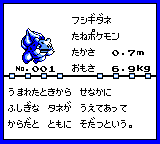 Bulbasaur's Pokédex entry in Pokémon Blue (GBC)


Connectivity
Players may trade Pokémon between two cartridges or battle with another cartridge using a Game Boy Game Link Cable. To take full advantage of this feature, several Pokémon are exclusive to other Generation I games and others require trading to evolve, making trading necessary to complete the Pokédex. The game can trade and battle with Japanese versions of Pokémon Red, Green, Blue, and Yellow. It can also trade with Japanese versions of Pokémon Gold, Silver, and Crystal via the Time Capsule. Pokémon Blue is completely incompatible with games from Generation III onward.
Trades between Pokémon games in different languages are possible; however, a Japanese game cannot connect with a non-Japanese game without causing corruption. This is due to the fact that the games cannot automatically translate the Pokémon data from Japanese to a different language or vice versa, since neither game fully encodes both kana and the Latin alphabet (only encoding one fully and the other partially). If a battle between a Japanese game and a non-Japanese game is attempted, the battle simply does not work, with the save files left unharmed.
Pokémon Blue is compatible with Pokémon Stadium, Pokémon Stadium 2 (released as Pokémon Stadium in English), and Pokémon Stadium G&S (released as Pokémon Stadium 2 in English). While link battles are not possible directly between Pokémon Blue and the Generation II games, a player may challenge a Generation II game using Pokémon Stadium G&S.
Virtual Console
The Nintendo 3DS Virtual Console release uses 3DS wireless communication as a substitute for the Game Link Cable. Japanese and non-Japanese Generation I core series games do not recognize each other when attempting to link them via 3DS wireless communication.
Using Poké Transporter, the entirety of Box 1 can be sent from the Generation I core series games to Pokémon Bank (regardless of language), from where they can be withdrawn in the Generation VII core series games.
Release
Pokémon Blue was first revealed in the cover-dated October 1996 issue of Monthly CoroCoro Comic (released September 15, 1996) in the preview section for the next issue.[5] The game was initially sold and distributed by Shogakukan as a limited edition exclusively through order forms included in the publisher's magazines; each form could be used to purchase up to two copies of the game.
To celebrate 1 million sales of Pokémon Red and Green, the first period of mail order sales was held from October 15 to December 27, 1996. Order forms were included in the November 1996 issue (released October 15, 1996) and December 1996 issue (released November 15, 1996) of Monthly CoroCoro Comic, and seven other magazines: Bessatsu CoroCoro Comic, Shōgaku Ichinensei, Shōgaku Ninensei, Shōgaku Sannensei, Shōgaku Yonensei, Shōgaku Gonensei, and Shōgaku Rokunensei. Because Pokémon Blue was made to order, shipments were not planned to begin until early December; orders postmarked by November 30 were expected to be delivered by December 31. Payments needed to be made at a post office via bank transfer form within 10 days after delivery.[6][7]
To celebrate 4 million sales of Red, Green, and Blue combined, a second period of special sales was held from June 13 to August 31, 1997. Order forms were included in the July 1997 issue (released June 15, 1997), August 1997 issue (released July 15, 1997), and September 1997 issue (released August 15, 1997) of Monthly CoroCoro Comic, the same seven other magazines, and five more magazines: Televi-Kun, Ciao, Shōjo Comic, Bessatsu Shōjo Comic, and Shōjo Comic Cheese!. In addition to mail order, readers could also have a pre-order fulfilled through a Lawson convenience store; full payment was required when the order form was submitted, but the game could be picked up nine days earlier compared to mail order. Orders were divided into four rounds depending on when they were submitted; orders placed by June 29 were expected to be available for pickup at Lawson starting July 16 or delivered starting July 25.[8][9]
Pokémon Blue was subsequently made available through Loppi machines at Lawson stores,[10] before ultimately being released to general retail on October 10, 1999.[1][2] The limited edition release can be distinguished from the general release by Shogakukan being listed as a sales partner and the lack of a barcode on the back of the game's box. October 15, 1996 (the date when mail orders began) is listed as Pokémon Blue's release date according to The Pokémon Company and Nintendo's official websites.[1][2][3]
Differences in the Virtual Console release
The Nintendo 3DS Virtual Console release can link with other Virtual Console Generation I and II core series games via Nintendo 3DS wireless communication, simulating the Game Link Cable. When initiating a link, the Virtual Console menu on the touch screen replaces the Cable Club attendant's dialogue.
Using Poké Transporter, Pokémon can be sent from the Generation I core series games to Pokémon Bank, from which they can be withdrawn in the Generation VII core series games.
The moves Blizzard, BubbleBeam, Confusion, Dream Eater, Explosion, Guillotine, Hyper Beam, Mega Kick, Mega Punch, Psychic, Reflect, Rock Slide, Selfdestruct, Spore, and Thunderbolt had their animations changed slightly to tone down the flashing.
The game was available on the Nintendo 3DS Virtual Console in Japan between the Pokémon 20th Anniversary on February 27, 2016, and the discontinuation of the 3DS Nintendo eShop in March 2023.
Development
- Main article: Pokémon Red and Green beta
An error made during development causes the Pokémon depicted during Professor Oak's introductory lecture to be a Nidorino but with the cry of a Nidorina. This was already the case in the Japanese Red and Green and it was not fixed in Red and Blue.
Soundtrack
- Main article: Game Boy: Entire Pokémon Sounds Collection CD
The soundtrack release for Pokémon Red and Green also applies to Pokémon Blue.
Staff
- Main article: Staff of Pokémon Blue (JP)
Gallery
Logos
-
 Japanese Blue logo

Title screens
When played on the Super Game Boy, Super Game Boy 2, Game Boy Tower, Game Boy Color, Game Boy Advance, or Game Boy Player, the game uses predefined color palettes instead of displaying in monochrome.
-
 Title screen (Game Boy)
-

-


Flyers
-
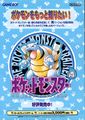 Front of Japanese flyer
-
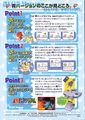 Back of Japanese flyer


Virtual Console icons
-
 Nintendo 3DS Virtual Console icon

Trivia
- Because Pokémon Red and Blue use a translation of the script of Pokémon Blue but use the in-game trades from Pokémon Red and Green, two translation errors related to these trades occur.
- The man who trades the player an Electrode on Cinnabar Island claims that the Raichu he received "went and evolved". As Raichu does not have an evolved form, this is not possible. However, in the context of Japanese Pokémon Blue, it makes sense as the player trades away a Kadabra, which evolves through trade, for a Graveler.
- The old man who trades the player a Jynx in Cerulean City claims that the Poliwhirl he received "went and evolved". As Poliwhirl cannot evolve via trade in Generation I, this is not possible. However, in the context of Japanese Pokémon Blue, the old man trades away a Haunter for a Machoke, which does evolve through trade.
- Pokémon Blue (Japanese) and Pokémon Yellow are the only core series games where no item was introduced.
- This is the only Generation I core series game in which neither Seel nor Dewgong is available through an in-game trade.
- This is the only Generation I game where Golem can be seen without physically linking to another Game Boy.
- Due to an oversight, Jigglypuff appears purple (instead of pink) in the battle against Gengar at the game intro. This is a leftover from the battle between two purple Pokémon (Gengar vs. Nidorino) in the earlier games Pokémon Red and Green.
- Sales of this game combined with Pokémon Green, the Japanese version of Pokémon Red, and the English versions of Pokémon Red and Blue exceed 31 million units, making these the highest selling Pokémon games as well as the only games in the series to exceed 30 million units.
In other languages
| Language | Title | |
|---|---|---|
| Japanese | ポケットモンスター 青 | |
| French | Pokémon Version Bleue | |
| German | Pokémon Blaue Edition | |
| Italian | Pokémon Blue Version | |
| Korean | 포켓몬스터 블루 | |
| Spanish | Pokémon Edición Azul | |
External links
References
- ↑ 1.0 1.1 1.2 1.3 ポケットモンスター 青 | ポケットモンスターオフィシャルサイト
- ↑ 2.0 2.1 2.2 2.3 ポケットモンスター青
- ↑ 3.0 3.1 3.2 Iwata Asks | 2. The King Of Portable Toys | Iwata Asks - Pokémon HeartGold Version & SoulSilver Version | Nintendo UK
- ↑ Missing Number
- ↑ CoroCoro - October 1996 (specifically the page about 1 million Pokémon sales)
- ↑ Translation: Forgotten Story of Pokemon Blue’s Release - Lava Cut Content
- ↑ 月刊コロコロコミック1996年12月号 レビュー - ゾイド総合ランド
- ↑ ポケットモンスター・ブルーバージョン再販中!! (Pokémon Blue Version Re-Release!!)
- ↑ CoroCoro - July 1997
- ↑ ライブドアニュース on Twitter

Related articles
Core series • Side series • Spin-off series • Standalone spin-offs • DLC • Pokémon mini • Betas • Demos

|
This game-related article is part of Project Games, a Bulbapedia project that aims to write comprehensive articles on the Pokémon games. |