

Pokémon Master Trainer (1999)
| Pokémon Master Trainer (1999) | ||||
_boxart.png) American cover of Pokémon Master Trainer  Canadian cover of Pokémon Master Trainer | ||||
| Release date | 1997 Japan 1999 Americas, Europe | |||
|---|---|---|---|---|
| Publisher(s) | Hasbro Milton Bradley | |||
| Age | 7+ | |||
| Players | 2 to 6 | |||
| External Links
| ||||
Pokémon Master Trainer was originally created and produced by Tomy in Japan in 1997 under the name Pocket Monsters Board Game (ポケットモンスターボードゲーム). It was translated into English for release outside of Japan in 1999 by Hasbro and Milton Bradley. The object of the game is to travel the Kanto region, capture and battle Pokémon (in the form of cardboard chips), and reach Indigo Plateau to battle one of the Elite Four members. All Generation I Pokémon (excluding Mew) are able to be caught in this game.
In the United States, the game was in English only. A fully bilingual (English and French) version of the game was released in Canada. It was also made available in other English-language countries, such as New Zealand.
Pokémon Master Trainer received two sequel games in 2000 (2001 outside of Japan) and 2005. The former is an iterative improvement over the original, featuring every Pokémon from the first two Generations (except for Celebi), while the latter is a different game altogether and only features 204 out of all 386 creatures available at the time.
Blurb
Can you catch the most powerful Pokémon™ and become the new Master Trainer™?
On your quest, travel from Pallet Town to Indigo Plateau, battling and defending every other trainer you meet on the way. You'll search for rare Pokémon in the Unknown Dungeon, and use Poké Balls to catch'em. Special cards will quickly change your fate. Catch an entire Pokémon Evolution Group for maximum Attack Strength. When you collect the ultimate Pokémon team and beat a Pokémon Master, you'll be the new Master Trainer!
Contents
Game includes:
- 1× Gameboard map of Pokémon World
- 150× Pokémon chips
- 5× Rival Cards
- 1× Storage tray
- 54× Item Cards
- 54× Event Cards
- 6× Ash movers
- 2× Dice
Object
Be the first player to collect 20 Power Points worth of Pokémon, defeat a Pokémon Master, and become the World's Greatest Pokémon Trainer!
Setup
.jpg)
Pokémon chips are stored in the storage tray, each color in a separate bin, facing away so players can't see which Pokémon they have on the other side. Some chips are taken from the tray and are placed in all of the big circular spaces on the board, matching the color of the chips to the color of the spaces. Only 37 chips can be placed at any given time, not counting the 4 yellow chips that should be mixed up and placed in the Unknown Dungeon at the bottom right of the board; the rest are kept in the storage tray.
The 6 Starter Pokémon chips (the ones with spiky edges) are Bulbasaur, Charmander, Squirtle, Pikachu, Clefairy, and Meowth. They are placed facedown next to the gameboard and mixed up. Each player chooses one chip and turns it over. Every player keeps their starter Pokémon near where they're sitting and if there are fewer than 6 players, the remaining Starter Pokémon chips are put away in the storage tray (they cannot be placed on the board).
The 5 Pokémon Rival Cards are shuffled and placed facedown in the center of Indigo Plateau on the gameboard. These cards will be used at the end of the game. Event Cards and Item Cards are shuffled and placed in two piles next to the board.
Each player picks an Ash mover. If wanted, they can be matched to the color from the Starter Pokémon chip they chose: Green mover - Bulbasaur; Orange mover - Charmander; Blue mover - Squirtle; Yellow mover - Pikachu; Pink mover - Clefairy; Beige mover - Meowth.
Gameplay
.png)
The game starts by placing all Ash movers in the Pallet Town space, at the lower left corner of the board. The Power Points of the Starter Pokémon each player chose determines who goes first. The player with the weakest Pokémon (lowest Power Points number) goes first and play passes to the left. In case of a tie for the weakest Pokémon, each trainer rolls a die and the highest roll goes first.
Traveling the land
During their turn, each player rolls one die. The Ash mover is moved that number of spaces along the board (cities count as spaces too). After leaving Pallet Town and until Cerulean City, players can only move in one direction. But once they reach Cerulean City, the road splits and they can choose between Lavender Town or Saffron City. Alternatively they can move backward towards a city they already passed, but "double back" onto any space is not permitted during the same turn.
Gameboard spaces
On the road to Indigo Plateau there are three main types of board spaces:
- City or Town—Most of these allow players to draw Item Cards when they land on them. There are two cities that have special Pokémon Centers that revive the player's knocked-out Pokémon.
- Catch'em!—When a player lands in one of these spaces, they may flip the Pokémon chip and try to catch it.
- Draw Event Card—The player takes the top card off of the Event Card deck and shows it to the other players.
.png)
Occupying spaces
If the die roll would have the player land on a space already occupied by another player's Ash mover, then they have to land on the next available empty space ahead on the road. Only the Cinnabar Island space can have more than one mover at the same time. However, if the player passes another Ash mover—by itself on a space—during any turn, they may instead choose to stay in that trainer's space to offer a Pokémon trade or fight a Trainer Battle. If there is more than one Ash mover on a space the player passes, they can't trade or fight any of those players. If the player chooses to trade or battle with another player during their turn, they do not follow the directions on that space (e.g. they wouldn't take a card if the space says "Draw Event Card").
Pokémon Trainer Skills
Each player has three skills they can make use of during their gameplay: Catch Pokémon, Trade Pokémon and Fight in a Trainer Battle.
Skill One — Catch Pokémon
From the moment players leave Pallet Town, they can start catching Pokémon. When the player lands on a Catch'em space, they have to flip the Pokémon chip to reveal the Pokémon. Each Pokémon chip has one or more dice symbols. The player must roll one of those numbers, using one die, to catch this Pokémon and make it part of their team.
Players may also use special Poké Ball Item Cards to help them catch Pokémon. These are played before rolling the die and can only be used once for each Pokémon, even if the player has multiple Poké Ball cards.
- Great Ball: The player decides whether to add or subtract 1 from their roll.
- Ultra Ball: The player can add 1 or 2 to their roll.
- Master Ball: The player can add 1, 2, 3 or 4 to their roll.
-
 Great Ball
 -
 Ultra Ball
 -
 Master Ball
.jpg)
.jpg)
.jpg)
If the Pokémon is caught, the player takes it off the board and puts it wit the rest of their team's chips. If the player reaches at least 20 by adding all the Power Points in their team, they can go immediately to Cinnabar Island. A Pokémon chip of the same color is taken from the storage tray and is placed facedown on the empty space on the gameboard. If there are no Pokémon chips left of that color in the storage tray, the gameboard space remains empty.
If the player didn't roll the number needed to catch the Pokémon, the Pokémon chip is left faceup in its space on the board where it was found. The same player or another one may try to catch it later.
Skill Two — Trade Pokémon
If the player's die roll has them pass another Ash mover, they have the chance to stop in that trainer's space and offer to trade Pokémon (as well as other incentives such as Item Cards). If the other player is not interested in the trade proposal, then the player continues and lands on the space they were headed for, based on the die roll. If the other player accepts the trade offer, the Pokémon chips are exchanged and both Ash movers stay on the same space on the board; the turn ends here.
Notes about trading:
- Starter Pokémon cannot be traded.
- If a player draws a Trade Pokémon Event Card, a trade with another player must take place.
Skill Three — Fight in a Trainer Battle
There are two ways a battle can take place. During a turn, if a player passes another Ash mover, they can stop in that player's space and challenge them to a Trainer Battle. The other way is by drawing a Let's Fight! Event Card, in which case the player must offer a challenge to any other player they choose. In either case, the challenged player has two options:
- Accept the challenge, or
- Stop the fight with a Poké Doll Item Card.
How to fight
- Players have to select a Pokémon from their team to battle.
- Players can select up to two Attack Bonus Item Cards to add Attack Strength to their Pokémon. They have to say how many cards they are using as bonus, if any, but they keep them secret and off to the side until after the die is roll.
- Each player rolls one die.
- Players turn over their Attack Bonus Item Cards. The following formula is applied to determine the battle total: Attack Strength + die roll + Attack Bonus Item Card(s) = Battle total
- In case of a tie, both players roll again
- The player with the highest Battle total is the winner. The winner takes two Item Cards at random from the loser of the battle. If the loser has only one Item Card, then the winner may draw a second Item Card from the top of the Item Card deck. If the loser doesn't have any Item Cards, then they both have to be taken from the Item Card deck.
- The Pokémon the loser fought with is now knocked out. The player has to turn this Pokémon chip facedown. Until it is revived, this knocked-out Pokémon:
- Cannot fight, or
- Add its Power Points toward the player's goal of 20.
- However, they can be traded for other Pokémon during a regular trade.
.jpg)
Reviving Pokémon
A knocked-out Pokémon can only be revived in these three ways:
- Play a Potion Item Card, or
- Draw a Pokémon Center Event Card, or
- Land on Cerulean City or Vermilion City. When a player lands on either of these spaces, they have two choices:
- Revive one of their knocked-out Pokémon
- If they have more than one knocked-out Pokémon on their team, they may take the Dice Challenge: Rolling 1 or 6 with one die revives all of their team's knocked-out Pokémon, but if they don't roll any of these numbers, then none of their Pokémon are revived.
Once a Pokémon is revived, it can again be used to fight and to add its Power Points toward the player's goal of 20.
Item Cards
.jpg)
Players may earn Item Cards during their gameplay, either by winning them in Trainer Battles or when drawing an Event Card. There are several Item Cards that can be used for their advantage.
|

.jpg)
.jpg)

.jpg)
.jpg)
.jpg)
.jpg)
.jpg)
Important notes about Item Cards:
- Item Cards can be collected and played when needed.
- An Item Card is used only once and then it's placed facedown at the bottom of the Item Card pile.
- A player may never have more than 7 Item Cards. If a player ends up with more than 7 Item Cards at the end of their turn, they must immediately discard (or play) the card(s) of their choice so that they end up with only 7.
- Some Item Cards can be used in conjunction with each other and played at the same time. Most Item Cards can only be played during the player's turn, but some can be played at other times during the game.
- A player can use as many Item Cards as they want during their turn, but only a maximum of two Attack Bonus cards can be used per battle.
Event Cards
.jpg)
A variety of Event Cards can affect the course of the game. After an Event Card is drawn, it is placed facedown at the bottom of the Evnet Card pile. Unlike Item Cards, Event Cards cannot be saved.
|
.jpg)
.jpg)
.jpg)
.jpg)
.jpg)
.jpg)
.jpg)
.jpg)
Evolution Bonus
.png)
If the player collects all of the Pokémon in an Evolution Group, the highest Pokémon gets an Evolution Bonus. This Evolution Bonus will increase the Pokémon's strength in battle. The game box cover can be used for reference to see all of the Pokémon in their Evolution Groups.
Set of Two
If a player collects both of the Pokémon in a set of two, they have to add 3 to the more evolved (stronger) Pokémon's Attack Strength. For example, if the player has a Pokémon in both of its two Evolution Group forms, such as Pikachu and Raichu, then the Raichu chip gets an automatic Evolution Bonus of +3.
Set of Three
If a player collects all of the Pokémon in a set of three, they have to add 5 to the most evolved (strongest) Pokémon's Attack Strength. For example, if the player has a Pokémon in all of its three Evolution Group forms, such as Bulbasaur, Ivysaur and Venusaur, then the Venusaur chip gets an automatic Evolution Bonus of +5.
.jpg)
Beginning the Final Battle
.png)
Cinnabar Island
A player doesn't need an exact roll to land on Cinnabar Island space and collect 2 Item Cards. For example, if the player rolls a 5 but they're less than 5 spaces away, they can advance to Cinnabar Island if they choose to. Even though players may land on Cinnabar Island during the course of the game, they may not continue on to Indigo Plateau unless they have the required 20 Power Points worth of Pokémon.
.jpg)
Indigo Plateau
When a player has at least 20 Power Points worth of Pokémon at the end of their turn, they immediately move to Cinnabar Island. They follow the directions on the Cinnabar Island space and on their next turn, they can enter Indigo Plateau, roll the dice and prepare fo the battle with one of the Pokémon Masters: Lorelei, Bruno, Agatha, Lance or Gary.
Once a player enters Indigo Plateau, they continue to travel clockwise, in the direction of the little arrows, around and around the hexagonal track until they land on an "ENTER Final Battle" space. Other players may catch up too. If they land on a "Catch [Red, Blue or Green] Pokémon" space, they have to choose any Pokémon chip of the matching color from the board, including ones that are faceup. Then they follow the usual rules for trying to catch a Pokémon.
When a player lands on "ENTER Final Battle" by exact count, all the other players roll one die. Whoever gets the highest roll (or the other player, if there are only two players) should then draw a Rival Card from the top of the pile and secretely look at it. That player will become one of the Pokémon Masters, for the duration of this battle only. Usually, one or two Attack Bonus Item Cards are needed to beat a Pokémon Master.
.jpg)
The Final Battle
If a player has entered the Final Battle, they must now choose a Pokémon from their team to fight with. They may also use up to two Attack Bonus Item Cards, just like in a regular Trainer Battle. Once they have revealed which Pokémon they have chosen for battle, the other player (who is roleplaying as the Pokémon Master) shows the Rival Card so the player knows who they're fighting. Each trainer rolls one die and adds the Attack Bonus, applying the same formula as in Trainer Battles. The Pokémon Master's Attack Bonus is determined by the die roll, shown at the bottom of the Rival Card. For example, if "Lance" rolls a 2, the Attack Bonus is 7, bringing the Battle total to 23 (Lance's Attack Strength of 14 + Attack Bonus of 7 + roll of 2 = 23). Pokémon Masters cannot use any Item Cards. In the case of a tie, both trainers roll again.
If the player beats one of the Pokémon Masters, the game is over and they win. If they lose, then the Pokémon that they chose to fight with is knocked out, and they must return to Cinnabar Island. Since knocked-out Pokémon don't add to the player's 20 Power Point target, they might have to revive that knocked-out Pokémon or catch more Pokémon before they can re-enter Indigo Plateau to challenge the Pokémon Masters once again.
The player that rolled for the Rival and won gets to draw two Item Cards from the deck as a reward. Then, all of the Rival Cards are shuffled and set back to the center of the Indigo Plateau. The next time someone enters a Final Battle, they roll again to see who will play as the Pokémon Master. The game continues until one of the players wins the Final Battle.
.jpg)
Rival Cards
There are 5 different Rival Cards based on the Elite 4 and champion from the Pokémon Red and Blue Versions: Lorelei with Lapras, Bruno with Machamp, Agatha with Gengar, Lance with Dragonite and Gary with Arcanine.
-
 Lorelei
 -
 Bruno.
 -
 Agatha.
 -
 Lance.
 -
 Gary.
Gary.
.jpg)
.jpg)
.jpg)
.jpg)
.jpg)
Pokémon Chips

As players traverse the board, they have the option to battle or catch different species of Pokémon, represented by cardboard chips. All Kanto Pokémon up to Mewtwo are available, and are classified into five categories based on power:
- Pink star-shaped chips (Starter Pokémon)
- Pink circular chips
- Green circular chips
- Blue circular chips
- Red circular chips
- Yellow circular chips (Legendary Pokémon)
The different classes of Pokémon can be found in different areas of the game board.
Starter Pokémon chips
There are six Starter Pokémon chips, which have spiky edges unlike the rest of the chips in the game. They are based on the Starter Pokémon from the Pokémon Red and Pokémon Blue games along with Pikachu, Clefairy and Meowth. They don't need a particular Dice Roll number to catch them since they are picked at the beginning of the game by each player. While their coloration is pink, they have higher Power Points and Attack Strength than the average Pink Pokémon chip.
List of Starter Pokémon chips:
|


Pink Pokémon chips
Pink chips include most of the unevolved Pokémon in the game. Their Power Points and Attack Power range between 1-3 and the Dice Roll needed to catch them is ⚂ ⚃ ⚄.
List of Pink Pokémon chips:
|


Green Pokémon chips
The second tier is the Green Pokémon chips. They include some unevolved Pokémon, but the vast majority are Pokémon that have evolved once. Their Power Points are either 4 or 5 and their Attack Strength ranges between 3-5. The Dice Roll needed to catch them is ⚃ ⚄.
List of Green Pokémon chips:
|


Blue Pokémon chips
The third tier is the Blue Pokémon chips. This is the most varied group as it includes unevolved Pokémon, Pokémon that have evolved once, fully evolved Pokémon and single stage Pokémon. Their Power Points are either 6 or 7 and their Attack Strength ranges from 5-7. The Dice Roll needed to catch them is ⚂ ⚃.
List of Blue Pokémon chips:


Red Pokémon chips
The next tier is the Red Pokémon chips. It includes mostly fully evolved Pokémon with the exception of Dragonair. Their Power Points are either 6 or 7 and their Attack Strength ranges from 6-8. The Dice Roll needed to catch them is ⚄.
List of Red Pokémon chips:
|


Yellow Pokémon chips
The final tier is the Yellow Pokémon chips. This includes the four legendary Pokémon: Articuno, Zapdos and Moltres whose Power Points are 8 and Mewtwo, with 9 Power Points. All of them have an Attack Strength of 9 and the Dice Roll needed to catch them is ⚅.
List of Yellow Pokémon chips:
|


Images
-
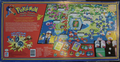 The back of the box
 -
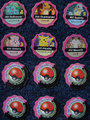 All six first Pokémon of the game
 -
 All six game pieces that can be used
 -
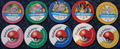 The five different chip colors, ordered weakest to strongest
 -
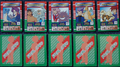 The rival cards featuring Gary and the Kanto Elite Four. They are thicker than other cards.
 -
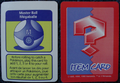 An item card
 -
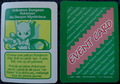 An event card
 -
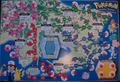 The game board, fully set up


Johto Version
At the beginning of the game, each player receives one of the game's six first Pokémon. The Pokémon available are Bulbasaur, Charmander, Squirtle, Chikorita, Cyndaquil, and Totodile. The Pokémon each player receives is selected at random. Using a colored token shaped like Ash Ketchum, players then move around the game board on roughly the same route as in the video games. Some choices in direction can be made. The player tokens are colored lilac, red, blue, green, yellow, and orange.
As players traverse the board, they have the option to battle or catch different species of Pokémon, represented by cardboard chips. All Pokémon up to Ho-Oh are available, and are classed into five categories based on power:
- The baby Pokémon Cleffa, Elekid, Igglybuff, Magby, Pichu, Smoochum, and Togepi — light blue circular chips except Tyrogue who is pink
- Weak, unevolved Pokémon, such as Grimer, first Pokémon — pink circular chips
- Slightly stronger, unevolved and evolved Pokémon, such as Pikachu and Hypno — green circular chips
- Strong, evolved Pokémon, such as Weezing — blue circular chips
- Very strong, fully evolved Pokémon, such as Charizard — red circular chips
- The legendary Pokémon Articuno, Zapdos, Moltres, Mewtwo, Mew, Entei, Raikou, Suicune, Lugia, and Ho-Oh — yellow circular chips
The different classes of Pokémon can be found in different areas of the game board.
In Japan the Johto version was released as Pocket Monsters Board Game 2 (ポケットモンスターボードゲーム2).
Trivia
- The inclusion of Clefairy as a first Pokémon alludes to the original Pokémon the Series pilot, where Ash's first Pokémon was a Clefairy. Clefairy is a main Pokémon of Red in the Pokémon Pocket Monsters manga.
- The artwork of the Kanto Elite Four strongly resembles their portraits in Pokémon Stadium and its sequel which were released after this board game.
Related articles

|
This article is part of Project Merchandise, a Bulbapedia project that aims to write comprehensive articles on all Pokémon toys, dolls, books, and collectible merchandise. |