

User:Frozen Fennec/Development Cycle of Pokémon Red and Green

|
Please feel free to edit this page. Major changes to this page should be discussed on the talk page. |
This page describes the development cycle of Pokémon Red and Green.

Capsule Monsters
During the year of 1990, Satoshi Tajiri showed off the concept for a game that would have been called Capsule Monsters. This game acted as a predecessor to Pokémon during it's development and would have introduced a new unique way of using the link cables for GameBoy Pockets to trade and battle with other players.
No Mew present
According to the interview by Satoru Iwata with Tsunekazu Ishihara and Shigeki Morimoto about the release of Pokémon HeartGold and SoulSilver, localized as Iwata Asks, they admitted that after the debugging tools were removed, they added Mew in the remaining space on the ROM. Nintendo thought that this would have been risky because altering the internal data after completing the testing period meant that any new bugs and/or glitches created by adding data without recurring to debugging tools would have been much harder to fix. Standard programming practices usually discourage altering the source code and not testing it just before releasing the software to the customer.[1]
Poké Balls
- Main article: Poké Ball
Some concept art depicts Poké Balls on the ground, in two pieces. This is most likely just a carryover from when Pokémon was still the concept of Capsule Monsters. Strangely, the original Poké Ball sprites from Pokémon Red and Green lack the button in the center of the Poké Ball.
Rebattling Trainers
In an interview with Shōko Nakagawa in her book Shōko Nakagawa: Pokémon Taught Me The Meaning of Life, Tsunekazu Ishihara revealed that originally, the game was programmed to trigger a battle with each Trainer any time the player walked by them, regardless if the player had already defeated them in battle previously. The wild Pokémon encounter rate was also significantly higher originally. The Trainer rebattling was omitted from the final release and the wild Pokémon encounter rate was significantly reduced.[2]
Release date
The games were originally scheduled for a December 21, 1995 release, according to an old Nintendo of Japan flyer.[3] This could explain the copyright year of 1995 that appears in the games' introductory sequence, and all subsequent games and official merchandise.
Prerelease border
On page 153 of the December 1995 book New Game Design by Game Freak is a summary of Red and Green's final plot. Two screenshots of the game are shown which use an unseen border resembling a Super Game Boy border. In it, "POCKET MONSTERS!" is written in a different size. The border has more Pokémon on it than the Super Game Boy borders from the final game. Clefairy and Pidgey are included, suggesting the screenshot may be from Japanese Red. Kangaskhan does not appear in the border.
-
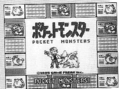 Title screen screenshot from New Game Design.
 -
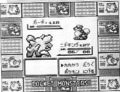 Battle screen screenshot from New Game Design.
 -
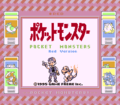 Final game's Super Game Boy border for comparison.


Concept art

During a gaming exhibition called Game On, early concept art of Capsule Monsters by Ken Sugimori was featured, along with pre-release material from Pokémon Ruby and Sapphire. The concept art depicts rough versions of various concepts that made it into the final releases of the Generation I games. They seem to include various battles, the Safari Zone, Red riding on a Lapras, a Blastoise, Celadon City, Silph Co., and a town with a fountain which could have been reworked into Celadon City. Some other Pokémon are identifiable in a raw or semi-normal form, such as Gastly, and others are prototypical of an entire class of Pokémon, such as a basic Dragon-type.
GameCenter CX

|
This section is incomplete. Please feel free to edit this section to add missing information and complete it. Reason: Expand based on the information provided by Satoshi Tajiri, if applicable |
A Japan-exclusive special Pokémon episode of GameCenter CX, known as Retro Game Master outside of Japan, included an interview with Satoshi Tajiri, where he revealed early Pokémon character profiles of Nidoking, Slowbro and Kadabra. Notably, they are given a National Pokédex number which matches their internal index number, rather than their final Kanto Pokédex number. Nidoking, for instance is noted as being #007, rather than #034, either suggesting that there was another method of ordering the Pokémon proposed, or that they reflect their ordering in the internal data. The latter is supported by interviews with Ken Sugimori, which verify that Rhydon, which has an index number of 001, was the first Pokémon ever created, and early sketches from Capsule Monsters featuring Rhydon. Nidoking is also referred to as マイコー♂ Maikō♂, indicating that there were either placeholder or alternate names for Pokémon before the development of Pokémon Red and Green had finished.
Pokémon names

During the promotional period that preceded the English release of both the anime and Pokémon Red and Blue, a large amount of Pokémon were shown with different names from those they had in the final releases. Some of these names were similar to their final names, but some were quite close to their Japanese names, and others were completely different from any current Pokémon name.
In addition to promotional materials distributed before the games' English releases, the book Pokémon Trainer's Survival Guide, one of the earliest player's guides available in North America, erroneously refers to Haunter as Spectre, its pre-release name.
| # | Final name | Early name | Japanese name | |
|---|---|---|---|---|
| 006 | 
|
Charizard | Charizr | Lizardon |
| 010 | 
|
Caterpie | Catterp | Caterpie |
| 014 | 
|
Kakuna | Kokoon | Cocoon |
| 015 | 
|
Beedrill | Beedril | Spear |
| 016 | 
|
Pidgey | Pidge | Poppo |
| 018 | 
|
Pidgeot | Pidgeott | Pigeot |
| 019 | 
|
Rattata | Rattatak | Koratta |
| 023 | 
|
Ekans | Nagahis/Arbo | Arbo |
| 024 | 
|
Arbok | Nagaasp | Arbok |
| 028 | 
|
Sandslash | Sandstorm | Sandpan |
| 035 | 
|
Clefairy | Aria | Pippi |
| 036 | 
|
Clefable | Ariala | Pixy |
| 037 | 
|
Vulpix | Foxfire | Rokon |
| 038 | 
|
Ninetales | Ninetai/Nine Tales | Kyukon |
| 039 | 
|
Jigglypuff | Pudding | Purin |
| 040 | 
|
Wigglytuff | Custard | Pukurin |
| 043 | 
|
Oddish | Ladish | Nazonokusa |
| 046 | 
|
Paras | Parasyte | Paras |
| 050 | 
|
Diglett | Digda | Digda |
| 058 | 
|
Growlithe | Flamie | Gardie |
| 059 | 
|
Arcanine | Blaze | Windie |
| 060 | 
|
Poliwag | Aqua | Nyoromo |
| 061 | 
|
Poliwhirl | Aquanau/Polihirl | Nyorozo |
| 062 | 
|
Poliwrath | Aquamar | Nyorobon |
| 063 | 
|
Abra | Hocus | Casey |
| 064 | 
|
Kadabra | Pocus | Yungerer |
| 066 | 
|
Machop | Karate/Kara-tee | Wanriky |
| 067 | 
|
Machoke | Kungfo/Kung-foo | Goriky |
| 068 | 
|
Machamp | Judoh/Ju-doh | Kairiky |
| 072 | 
|
Tentacool | Jilly | Menokurage |
| 073 | 
|
Tentacruel | Manowar/Man O War | Dokukurage |
| 078 | 
|
Rapidash | Gallop | Gallop |
| 079 | 
|
Slowpoke | Slowmo | Yadon |
| 081 | 
|
Magnemite | Coil | Coil |
| 082 | 
|
Magneton | Recoil | Rarecoil |
| 083 | 
|
Farfetch'd | Fowler | Kamonegi |
| 084 | 
|
Doduo | Dodo | Dodo |
| 087 | 
|
Dewgong | Manaty | Jugon |
| 092 | 
|
Gastly | Spirit | Ghos |
| 093 | 
|
Haunter | Spectre | Ghost |
| 094 | 
|
Gengar | Phantom | Gangar |
| 096 | 
|
Drowzee | Sleeper | Sleep |
| 099 | 
|
Kingler | Kingle | Kingler |
| 102 | 
|
Exeggcute | Eggstre | Tamatama |
| 103 | 
|
Exeggutor | Eggscut | Nassy |
| 104 | 
|
Cubone | Orphon | Karakara |
| 105 | 
|
Marowak | Guardia | Garagara |
| 106 | 
|
Hitmonlee | Lee | Sawamular |
| 107 | 
|
Hitmonchan | Chan | Ebiwalar |
| 108 | 
|
Lickitung | Tonguetyd | Beroringa |
| 109 | 
|
Koffing | Ny | Dogars |
| 110 | 
|
Weezing | La | Matadogas |
| 113 | 
|
Chansey | Lucky | Lucky |
| 114 | 
|
Tangela | Medusa/Meduza | Monjara |
| 118 | 
|
Goldeen | Goldy | Tosakinto |
| 119 | 
|
Seaking | Neptune | Azumao |
| 122 | 
|
Mr. Mime | Mrmime | Barrierd |
| 123 | 
|
Scyther | Stryke | Strike |
| 130 | 
|
Gyarados | Skulkraken | Gyarados |
| 131 | 
|
Lapras | Ness | Laplace |
| 132 | 
|
Ditto | Morpho | Metamon |
| 133 | 
|
Eevee | Eon | Eievui |
| 137 | 
|
Porygon | Poregon | Porygon |
| 138 | 
|
Omanyte | Ess | Omnite |
| 139 | 
|
Omastar | Kargo | Omstar |
| 140 | 
|
Kabuto | Att | Kabuto |
| 141 | 
|
Kabutops | Lantis | Kabutops |
| 142 | 
|
Aerodactyl | Ptera | Ptera |
| 147 | 
|
Dratini | Dragoon | Miniryu |
| 148 | 
|
Dragonair | Dragyn | Hakuryu |
Text

Before the English releases of Pokémon Red and Blue, screenshots were released of a battle with the rival where the text string "The Blue wants to fight!" was used. While this text would work with a typical Trainer, such as "The Lass wants to fight!" or "The Hiker wants to fight!", as they were not given personal names until Generation II, it would cause problems with Gym Leader, Elite Four, rival, and link battles, leaving them to end up as "The Misty wants to fight!" or "The Lance wants to fight!", as these Trainers did not at the time have titles, only their names. Because of this, the definite article The was dropped in the final releases, leading to the somewhat odd sentence style in Generations I and II of:
A screenshot in the instruction manual of English Red and Blue still contains the text "The Brock wants to fight!", possibly suggesting a late removal. The instruction manual also mentions Pokémon Leaders instead of Gym Leaders.
A slightly different grammar was also going to be used for other text strings.
- "{Player} sent {Pokémon} out!" instead of "{Player} sent out {Pokémon}!"
- "A wild {Pokémon} appeared!" became just "Wild {Pokémon} appeared!" (this change would be reverted in Pokémon XD: Gale of Darkness, where it has been kept since then)
- Similarly, "The enemy {Pokémon} fainted!" became simply "Enemy {Pokémon} fainted!" (also reverted in XD as the definite article The was reinstated)
In a screenshot from the instruction manual, Professor Oak says "PLANT POKé BULBASAUR?" instead of "plant POKéMON BULBASAUR?" as in the final game.