

Talk:Farigiraf (Pokémon)
Farigiraf's Origin
Hi, I'd like to contest the proposed origin for Farigiraf. More specifically the following excerpt:
It also shares traits with the Sivatherium or the Decennatherium, which are four-horned prehistoric relatives of the giraffe — fossils of Decennatherium have only ever been discovered in Spain.
I questioned and removed this proposal a few years ago, which caused some disagreement with the user that had added it. Staff that mediated the decision at the time seems to have misunderstood my issue with it and thought I was just complaining about some redundancy. It's been a while, enough for me to reopen this for discussion again, now in a more public manner.
After all these years, I keep coming back to this and arriving to the same conclusion. To be as clear as possible: Sivatherium and Decennatherium are horrid explanations. Stretchy nonsense.
The entire proposed theory revolves around two details: these ancient relatives of giraffes possessing four ossicones (the "horns" or "antennas"), and their fossils being found in Eurasia (with Decennatherium supposedly being found only in Spain).
The issues with this theory:
- The main issue is pretty evident, as both the Sivatherium and Decennatherium don't resemble modern giraffes in the slightest ({1}{2}{3}{4}. Visually they are both more similar to the okapi, or arguably even other families from the Pecora infraorder like bovids and cervids. Reconstructions of Sivatherium, as an example, have been historically depicted as moose-like. If the idea really was to reference some random ancestor that doesn't look like a giraffe, it seems unreasonable for Farigiraf's design to be an even more anatomically accurate depiction of modern giraffes than Girafarig. The idea that the four antennas are a nod to such an obscure detail while the rest of the design takes the complete opposite direction is just unreasonable. The addition of the extra antennas in Farigiraf are much more likely a design choice to simply illustrate how both heads in Farigiraf "merged" upon evolution or even to compensate for its lack of visible ears.
- The second issue is regarding Decennatherium specifically. This is clearly a showcase of people obsessing with assuming that everything has to do with the real world inspiration of the region the Pokémon is in. This sort of confirmation bias actually opened space for misinformation, as — unlike what's in Farigiraf's page — Decennatherium fossils have not only been found in Spain but also in other countries like Iran and Pakistan. Giraffes are associated with African savannas, pronto. There's no decent explanation to assume the designers made absurd logical jumps and dug up obscure paleontological species just to find a loose incorrect connection to Spain.

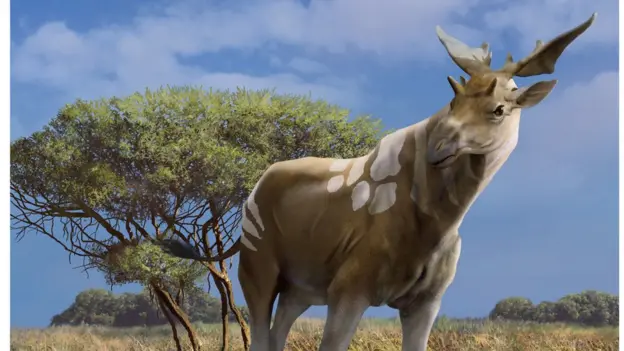

Due to the points brought up, I'd like to propose once again the removal of these theories, as I believe they lower the quality of Farigiraf's origin section in a misleading attempt to push for extremely weak or non-existent links.
ExLight (talk) 14:17, 31 July 2025 (UTC)
- really sorry for not replying to this sooner. tried to gather my thoughts on this one before writing a reply.
- for one thing, it is true that you can interpret Farigiraf's four horns as nothing more than a simple doubling of Girafarig's horns, what with Farigiraf essentially having 2 heads and all. and the giraffe precursors do look pretty not-giraffe-y (though it's worth noting i only subscribe to the Decennatherium hypothesis, the Sivatherium thing was added later and i lowkey disagree with that one due to how moose-like its horns look).
- on the other hand, we know Game Freak likes to put real world animal biology and folklore into their Pokémon designs (Palafin is a good example), and i don't think it's a stretch to assume one of the designers read up on "a giraffe ancestor with 4 horns" and consciously made Farigiraf to look like that. as for visual reconstructions, according to my research only the bones of the Decennatherium has ever been discovered, not its skin, so "visually they look like an okapi" doesn't really help since those artists on the research papers are also doing educated guesses.
- the best way i can reconcile this is probably something like "Farigiraf also shares some similarities, most notably its four horns, with the Decennatherium, an ancient ancestor of the giraffe whose fossils have been found in various places, including Spain." but im open to other suggestions.
- anZAsquiddles 2222(:D)SSSS (talk) 17:06, 10 August 2025 (UTC)
- I understand that the designers are fairly knowledgeable in folklore and biology and often add interesting biological references of their real life counterparts to Pokémon. Which includes references to certain behaviors (Komala referencing how koalas are the animals that sleep the most, Trapinch using sand pits to predate like antlions, Watchog and Patrat being alert to their surroundings as mammals like groundhogs, and many other more) and real life relationships (like Yungoos and Alolan Rattata, the mushrooms on Paras, Seviper and Zangoose, Mareanie and Corsola, Remoraid and Mantine, etc).
- However, I simply strongly disagree with Decennatherium being the case. As far as I can tell, there are no real hints at it being a possible inspiration. Nothing points to it being ancient on the Dex entries (compare that to something like Mamoswine) nor in depictions across different medias. To me, this lack of small nods and the very fact Decennatherium resembles nothing like a giraffe is far more definitive than Farigiraf having four "horns" (notably much different from Decennatherium's ossicles) or being introduced in a Spanish region.
- My suggestion is as straightforward as removing this theory off the page and attempting to focus on explanations for other more relevant aspects of Farigiraf, such as the decision to turn its tail on a head armor.
- ExLight (talk) 22:50, 10 August 2025 (UTC)