

Pokémon Memory
| Pokémon Memory | ||||
 1999 Version front box cover | ||||
| Release date | 1999 [Generation I]
2000 [Generation II] | |||
|---|---|---|---|---|
| Publisher(s) | Hasbro | |||
| Age | 3+ | |||
| Players | 1+ | |||
| External Links
| ||||
Pokémon Memory is a board game licensed by Hasbro and Milton Bradley. It is a Pokemon-branded version of Hasbro's Memory. Two versions were released, one in 1999 featuring Pokémon from Generation I, and a second version in 2000 featuring Pokémon from Generation II. It is for one or more players and designed for ages three and up.
Contents
- x48 Pokémon
- x1 Plastic Tray
Setup
- Carefully punch the 48 tokens out of the cardboard sheet.
- Mix and spread the tokens face-down on a flat surface.
- Form 8 rows of tokens across and 6 rows of tokens down, using all 48 tokens (24 pairs). The game can be simplified for beginners by dividing the tokens in half (12 pairs) and forming 6 rows across and 4 rows down.
Gameplay
With multiple players
The youngest player goes first. If there are more than two players, turn order moves clockwise from the first player. On their turn, a player flips any two Pokémon tokens face-up. The tokens must be turned over completely so that all players can see them.
A Match: A match is when the two tokens turned face-up are identical. When a match is made, the player takes both tokens and places them in front of them. They then take a second turn and may continue to do so until they "miss".
A Miss: The player misses if the two tokens turned over are not identical. When they miss, they turn the two tokens face-down again, in the same place. Their turn ends and plays moves to the next player. Players must try to remember which tokens are in which places so that they may make matches easily on future turns.
The game continues until all tokens have been matched and removed from the playing area. All players then count up their matching pairs and the player with the most matched pairs is the winner. If two or more players have the same number of matching pairs, the player who found the Chikorita pair wins the game.
Solo Play
Pokémon Memory can also be played alone ("Solo Play"). In Solo Play, the rules are the same as with multiple players, but the objective is to match all the pairs of tokens in the fewest number of turns possible.
Pokémon featured
1999 version
- Venusaur
- Charmander
- Charmeleon
- Charizard
- Wartortle
- Blastoise
- Caterpie
- Pidgey
- Rattata
- Raichu
- Nidoran♂
- Zubat
- Parasect
- Venonat
- Meowth
- Golduck
- Growlithe
- Geodude
- Ponyta
- Slowbro
- Dodrio
- Dewgong
- Kingler
- Chansey
2000 version
- Chikorita
- Bayleef
- Meganium
- Cyndaquil
- Quilava
- Typhlosion
- Totodile
- Croconaw
- Feraligatr
- Sentret
- Hoothoot
- Ledyba
- Spinarak
- Togepi
- Mareep
- Bellossom
- Marill
- Hoppip
- Slowking
- Snubbull
- Heracross
- Donphan
- Elekid
- Lugia
Gallery
-
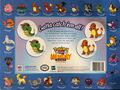 1999 Version back box cover
 -
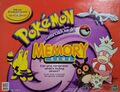 2000 Version front box cover
 -
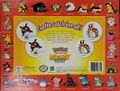 2000 Version back box cover


|
This article is part of Project Merchandise, a Bulbapedia project that aims to write comprehensive articles on all Pokémon toys, dolls, books, and collectible merchandise. |